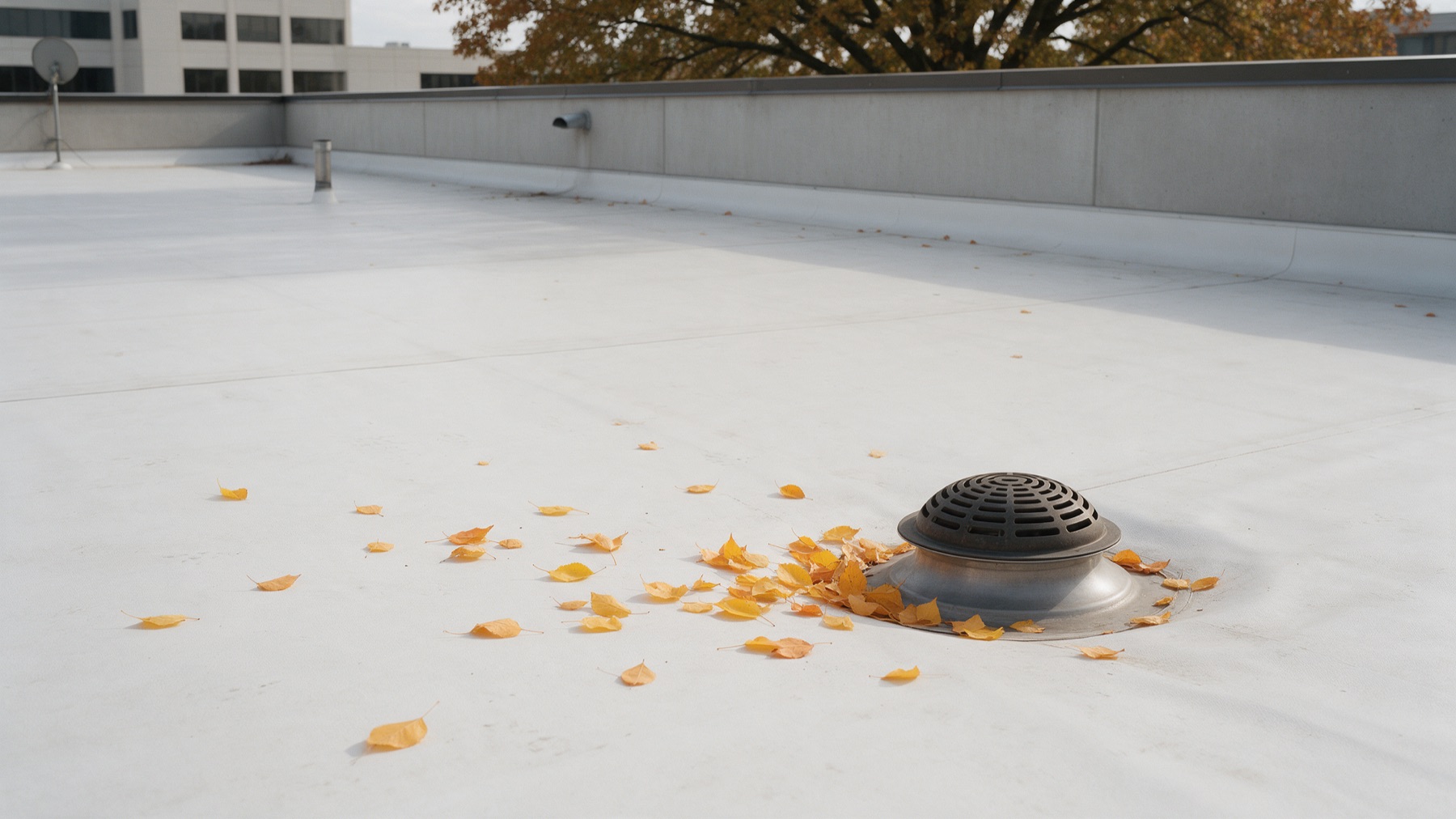
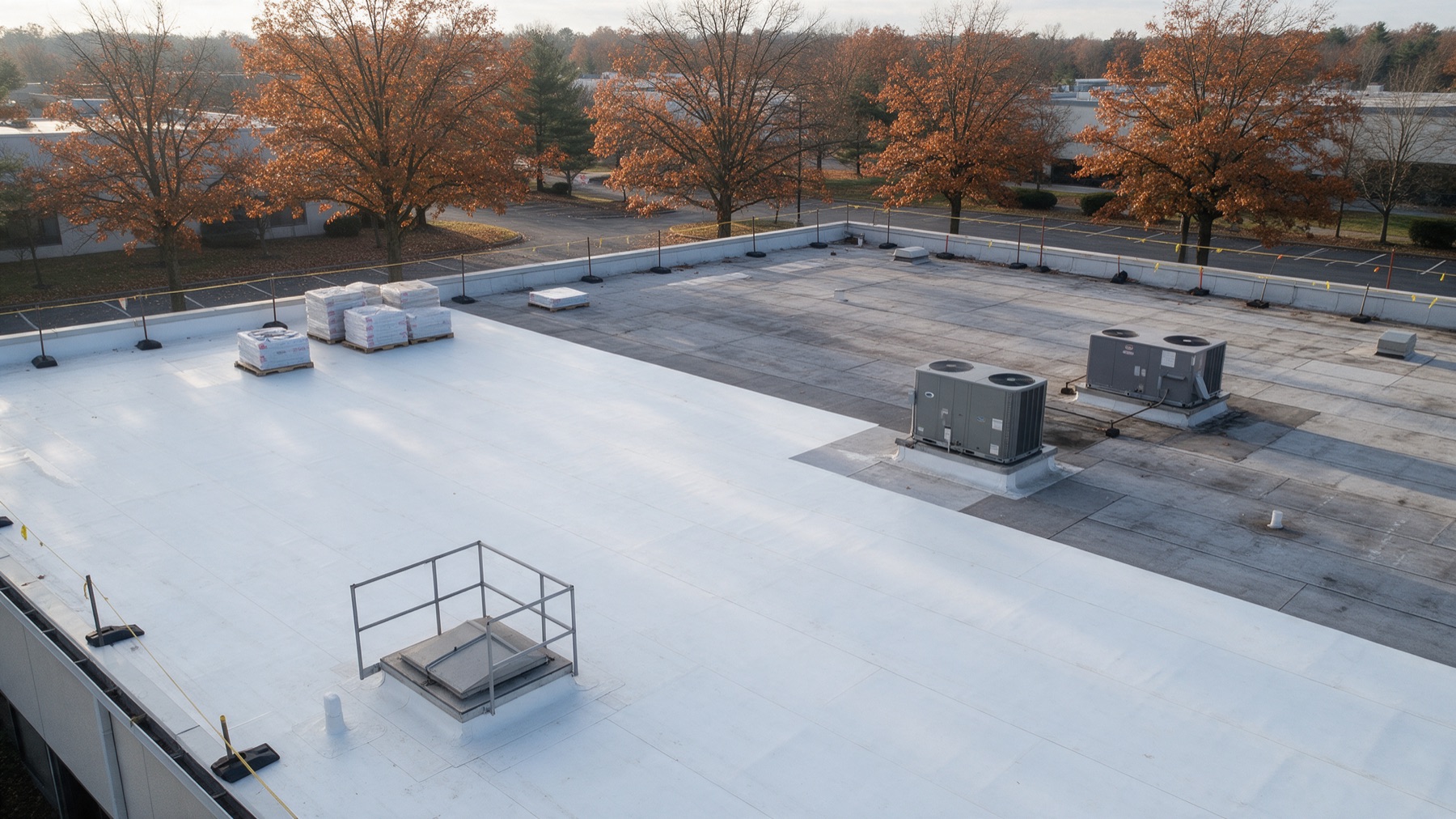
Trees overhanging a commercial roof do their damage in two seasons. In fall, the leaves arrive all at once and head for the drains. In summer and winter, the limbs do the work: scraping, dropping twigs and, once in a while, coming down in a storm. In the DMV, with mature canopy around so many office parks, schools and apartment buildings, mid-October is the point where this becomes a drainage problem, not a landscaping one.
Most of what a facility team needs to do about it is looking, logging and scheduling. This post covers what to watch, a simple fall routine, and where the job passes to an arborist or a roofer.
What trees actually do to a flat roof
Trade guidance on routine roof maintenance is consistent on the basics. Facilitiesnet's roofing maintenance tips list trimming limbs that could fall on the roof, removing debris and keeping drains and scuppers free flowing. Buildings.com makes the same points and adds that sharp debris should come off the membrane promptly and that deferred maintenance lets vegetation take hold.
In practice the problems fall into four groups:
Debris and ponding feed each other. A 2005 Tech Today column in Professional Roofing notes that ponded water is detrimental to most low-slope membranes and that plant and fungal growth can develop in ponded areas. A blocked drain makes the pond. The pond then holds more debris.
The fall routine: leaves down, drains clear, record kept
Most of this can be done without anyone stepping on the roof surface.
- Walk the ground first. Look up from each side of the building. Note any limb that overhangs the roof edge, touches the parapet or hangs over a rooftop unit. Binoculars help. Take a photo of each from the same spot every year.
- Mark the trees on a site plan. Number each tree, note which roof area and which drains sit beneath it. When a drain keeps clogging, you will know which tree is responsible.
- Time the cleaning to the leaf drop. In the mid-Atlantic that usually means a check in late October and another in late November or early December, after the leaves are down. A single early-October visit misses most of the load.
- Check the drains and scuppers. Our drain maintenance guide walks through the strainers, the secondary drains and how to read an overflow that has run.
- Log what you found. Date, who looked, what was in the drain, photos. A short, dated record is the sort of paperwork a manufacturer asks for if a warranty claim ever arises.
- Re-check after the first heavy rain. If water is still standing 48 hours later in conditions that allow drying, it is a drainage question for a roofer, not a cleaning job. The ponding measurement guide shows how to document it.
Before anyone goes onto the roof
If your employees go on the roof to clear a drain, OSHA's walking-working surface rules apply. On a low-slope roof, 29 CFR 1910.28(b)(13) sets three tiers:
Skylights and other holes have their own rule in 1910.28(b)(3). The full table and a skylight reminder are in our fall roof maintenance checklist. The simple policy: nobody goes near an edge, and the drains at the edge are cleaned by a roofer or contractor who has the equipment and the training.
For a drain that is well inside the 15-ft line, with a written policy and a dry, calm day, clearing leaves by gloved hand or a plastic scoop is housekeeping. Use nothing sharp, and do not use a pressure washer or leaf blower aimed at seams. If you are unsure whether a tool is safe on your membrane, ask the manufacturer or your roofer first.
Who deals with the tree
Cutting limbs is not a roofer's work and not a job for maintenance staff on a ladder. Hire a qualified arborist, ask for proof of insurance and check what certification they hold. A pruned limb that lands on the membrane causes the same damage you were trying to prevent, so agree the drop plan before the saw starts.
Check the local rules before anything large is cut:
- DC. DDOT's Urban Forestry page states that removing a tree between 44 and 99.9 inches in circumference requires a Special Tree Permit, and that Heritage Trees over 100 inches cannot be removed. That page is written for public space, so ask DDOT whether a permit applies to your tree on private property before you commit.
- Maryland and Virginia. County and municipal tree, forest-conservation and landscape-plan conditions vary. If your site plan or HOA covenants required the trees, check before removing them. Your county's permitting office can tell you; see our Montgomery County and Fairfax County pages for contacts on roof permits.
If you trim and the shade lifts, the roof will dry faster. If you keep the trees, accept a tighter cleaning schedule and write it into the maintenance plan.
When it becomes a roofer's job
The tree is a cause. The roof is where the damage shows. Call a roofer when:
- A drain is clear but water still stands more than 48 hours after rain.
- You see a cut, scrape, puncture or gouge in the membrane, or a flashing that has been struck or bent.
- A limb has landed on the roof. Leave it for the contractor; do not drag it across the surface.
- Moss, algae or vegetation is growing in a low spot.
- Debris keeps returning to the same drain after cleaning.
- A drain at or near the edge needs clearing.
- You find a new stain on a top-floor ceiling. See our guide to tracing a ceiling stain.
A scheduled roof maintenance program takes the edge-zone drains and the debris sweeps off your team's plate, and gives you a dated report of each visit. For damage, commercial roof repair is the next step. Never patch the membrane yourselves; many sealants are incompatible with TPO, PVC or EPDM, and an unauthorised repair can put a warranty at risk.
FAQ
How often should leaves be cleared from a commercial flat roof?
Check and clear drains at least in spring and fall, and again after the leaves finish dropping. Buildings under heavy canopy may need a visit every few weeks from late October through early December. Your manufacturer's maintenance guidance and your roofer can set the schedule.
Are overhanging branches bad for a flat roof?
They add debris, can scrape the surface and can fall in a storm. Facility maintenance guidance generally recommends trimming limbs that could drop onto the roof. Use an arborist, not a roofer or a ladder.
Can our maintenance staff clean the roof drains?
Only if your fall protection policy allows it, the drain is well clear of the edge, and the roof is dry. Drains within 15 ft of an edge should go to a contractor. Housekeeping only: no patching, cutting or pressure-washing.
Do I need a permit to remove a tree near my building in DC?
It may be required. DDOT publishes a Special Tree Permit threshold of 44 inches in circumference for removal. Confirm with DDOT's Urban Forestry Division whether it applies to your tree.
Will leaf debris void my roof warranty?
Check your own warranty. Many manufacturers expect owners to keep drains clear and records of maintenance, so a neglected roof can complicate a claim. Keep dated photos and a log.
Book a free 30-minute consultation at https://dmvcommercialroofing.com/#book or call 202-798-7663. The consultation leads to a written condition report.
Header image: AI-generated illustration (Magnific).