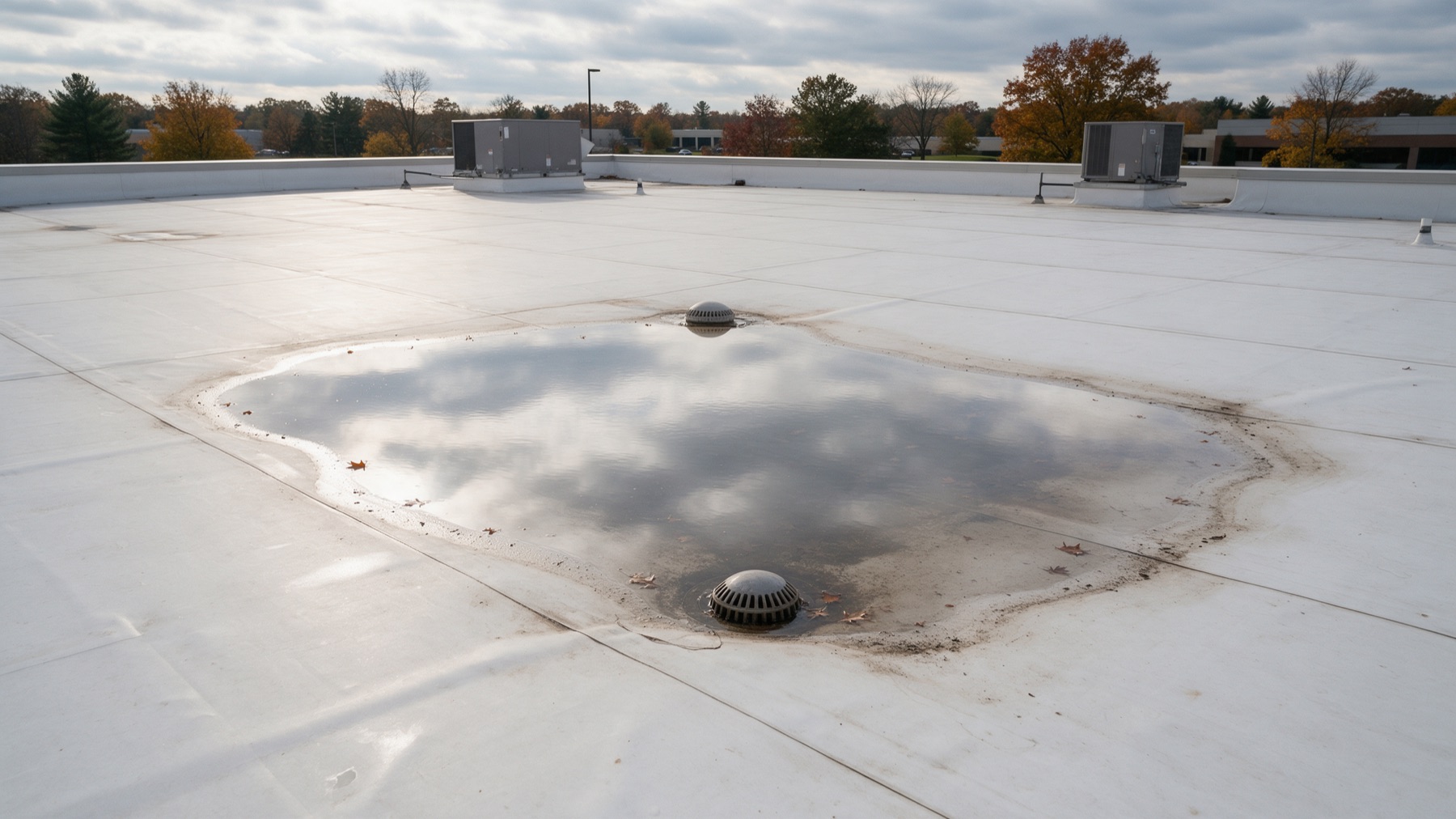
Every flat roof holds some water after a storm. The question a board or a facility director has to answer is different: is the puddle on our roof normal, or the start of a drainage, warranty or structural problem? Ponding water on a commercial roof is one of the few roof conditions your own team can measure with a ruler and a phone, and a good record of it changes what a roofer, a manufacturer or an engineer can tell you later.
The 48-hour rule
The dividing line is time, not size. NRCA's long-standing test is that there should be no ponding water on the roof 48 hours after a rain, in conditions conducive to drying. The building code uses the same clock: the 2021 International Building Code, as adopted in Maryland and Virginia, defines positive roof drainage as a design that accounts for deflection under all design loads and has enough extra slope to drain the roof within 48 hours of precipitation. Warranty language follows suit. The industry generally defines ponding as water that remains on a roof 48 hours or longer, in the words of one manufacturer's warranty guide.
So a sheet of water the morning after a storm is standing water, and normal. The same water on the third dry day is ponding, and belongs in a log. The drying clause matters in the DMV: in a humid August week or a grey November stretch, water can sit three days through no fault of the roof, so note the weather when you log it.
Why a pond is more than a cosmetic problem
It is heavy
The code's rain-load formula uses 5.2 pounds per square foot for each inch of water, which is simply the density of water, 62.4 pounds per cubic foot, divided by twelve (IIBEC Interface, Patterson and Mehta, 2020).
A pond the size of a parking space, two inches deep, weighs about as much as a mid-size car, applied exactly where the deck is already lowest.
It shortens the membrane's life
According to the Construction Specifier, roofing bitumens contain compounds that dissolve under the sustained pressure of standing water, and some single-ply adhesives deteriorate the same way. Ponds also collect silt that holds moisture against seams, and they freeze solid in January.
It can void the warranty on the wet area
Wording varies by manufacturer and membrane, so read your own. Johns Manville's owner guide to its Peak Advantage guarantee lists damage due to improper drainage (ponding water) among the exclusions, with TPO and PVC coverable by prior approval. If a leak ever appears under a pond you knew about, the first thing the manufacturer asks for is your maintenance record. The log below is that record.
Before anyone measures anything: the edge rules
If employees go on the roof, OSHA's low-slope rules in 29 CFR 1910.28(b)(13) apply: fall protection within 6 feet of any edge, protection or a marked designated area between 6 and 15 feet, and an enforced work rule beyond that. Skylights are holes. The full table is in our fall commercial roof maintenance checklist.
For ponding, add these:
- Only measure ponds 15 feet or more from every edge, lower roof and mechanical well. A pond against a parapet is photographed from 15 feet back and goes on the roofer's list.
- Do not walk into a pond. You cannot see what is under it, and wet membrane is slick. Read the ruler from the dry edge.
- Dry, calm, daylight only. Never on frost, snow or ice.
- Clearing leaves off a strainer dome is housekeeping. Cutting, sealing, pumping, probing or pressure-washing the membrane is not. If the water will not leave, the roofer decides how it leaves.
How to measure and photograph ponding water on a commercial roof
The aim is a record a stranger could read in two years. Consistency beats precision.
1. Pick the moment. Start the clock when the rain stops. Go up 48 hours later if it has stayed dry, or on the first dry day after that. Note date, time, when the rain ended and roughly how much fell; National Weather Service readings for Reagan National, Dulles or BWI are good enough.
2. Map the ponds once. On a roof plan or a satellite printout, number every pond and tie it to fixed features: drain, curb, parapet, skylight. The numbers never change.
3. Measure depth. A 12-inch steel rule set vertically at the deepest point, read from the dry side, to the nearest eighth of an inch. If the deepest point is unreachable from dry membrane, record the nearest reachable depth and say so.
4. Measure extent. Pace the long and short dimensions, or run a tape from a fixed feature to the water's edge. Chalk the high-water line well back from the water; next visit shows whether the pond is growing.
5. Shoot the same four photos every time.
The tide line is the most useful picture. A dark ring well outside today's water means the pond is usually bigger than what you are looking at.
6. Write it down the same way.
Two readings a year, plus one after any storm the roof will remember, is enough to see a trend.
Reading the pattern
Where a pond sits says more than how deep it is.
- Around a drain or scupper. Usually the least worrying. Drains sit at low points, and a shallow sump that clears within 48 hours is normal. If it does not, the line below may be slow; see our guide to roof drains, scuppers and overflows.
- Against a curb, wall or parapet. Water is being dammed. The usual fix is a cricket of tapered insulation behind the obstruction, a reasonable roofer's job.
- In the middle of a bay, away from any drain. The one to watch. Water at mid-span means the deck or framing is lower there than at the drains, built that way or deflected since. This is the pattern behind the structural question below.
- Growing year on year. A tide line that moves outward each season, with no change in drains or debris, says the roof is getting lower.
When it becomes a structural question
Engineers call the failure mode ponding instability: a deck that is not stiff enough sags under the water it holds, the sag holds more water, and the cycle continues until something gives. The code requires designers to evaluate susceptible bays for it under ASCE 7 (IBC §1611.2); the triggers include any roof sloped at less than a quarter inch per foot and any area where water would collect with the primary drains blocked.
Your log cannot run that calculation, but it can tell an engineer whether to. Call a structural engineer, not only a roofer, when you see:
- A mid-bay pond deeper or wider than last year
- Water more than about 2 inches deep anywhere for more than 48 hours
- Visible sag in the ceiling, joists or deck below the pond, or top-floor doors and partitions that have started to bind
- New cracks at the top of walls or columns under the area
- A roof built flat or near-flat on long-span steel joists or a light wood deck
- Ponding plus snow. Rain on packed snow is the loading that collapses low-slope roofs in this region
Any of those, and the roof gets looked at before the next big storm, not after. Keep people out from under the area until someone qualified says otherwise.
Fixing it is a design job, not a maintenance job
The code sets the design slope for built-up, modified bitumen and single-ply roofs at a quarter inch per foot (IBC §1507). For reroofing, §1512.1 waives that minimum, and the requirement to add secondary drains, only where the existing roof already has positive drainage. So a roof that ponds badly today has to be corrected at replacement, with tapered insulation, crickets, added drains or re-pitched sumps. Settle that before you accept a commercial roof replacement bid; it is a fair reason for two bids to be far apart.
Two honest cautions. A coating over a pond is not a fix: the water sits just as long on a coated roof, and most coating warranties exclude ponded areas, so ask about restoration only once drainage is dealt with. And if the insulation under a chronic pond is wet, it comes out, whatever the membrane looks like.
When it becomes a roofer's job
- Any pond still present 48 hours after rain in drying weather, logged twice
- A tide line well outside the current water
- A pond against a curb, wall or parapet that would need a cricket
- A drain sump that stays full with a clear strainer
- Vegetation, blisters, open seam edges or soft spots in or around the pond
- Any of the structural signs above (roofer and engineer together)
A drain problem or a missing cricket is ordinary commercial roof repair. A roof maintenance program puts the twice-yearly ponding log on someone else's calendar, photographs included.
FAQ
How long can water sit on a flat roof before it's a problem?
Industry practice, the code's definition of positive drainage and most warranties use 48 hours after rain stops, in drying weather. Gone by then, it is standing water. Still there, it is ponding.
How much does ponding water weigh on a roof?
About 5.2 pounds per square foot for every inch of depth. A two-inch pond covering 200 square feet weighs roughly a ton.
Does ponding water void a commercial roof warranty?
Often, for the ponded area. Several manufacturers exclude damage from ponding or improper drainage, sometimes with exceptions for TPO and PVC by prior approval. Read your own exclusions page and keep a dated log with photographs.
Can our maintenance staff pump the water off the roof?
Clear the strainer dome if leaves block it; that is housekeeping. Do not pump, cut, probe or wash. Pumping treats the symptom and puts people on a wet membrane. Log the pond and have a roofer find out why it is there.
If your log shows a pond that keeps coming back, book a free 30-minute consultation or call 202-798-7663. Bring the photos and the depths; they will shorten the conversation.
Header image: AI-generated illustration (Magnific).