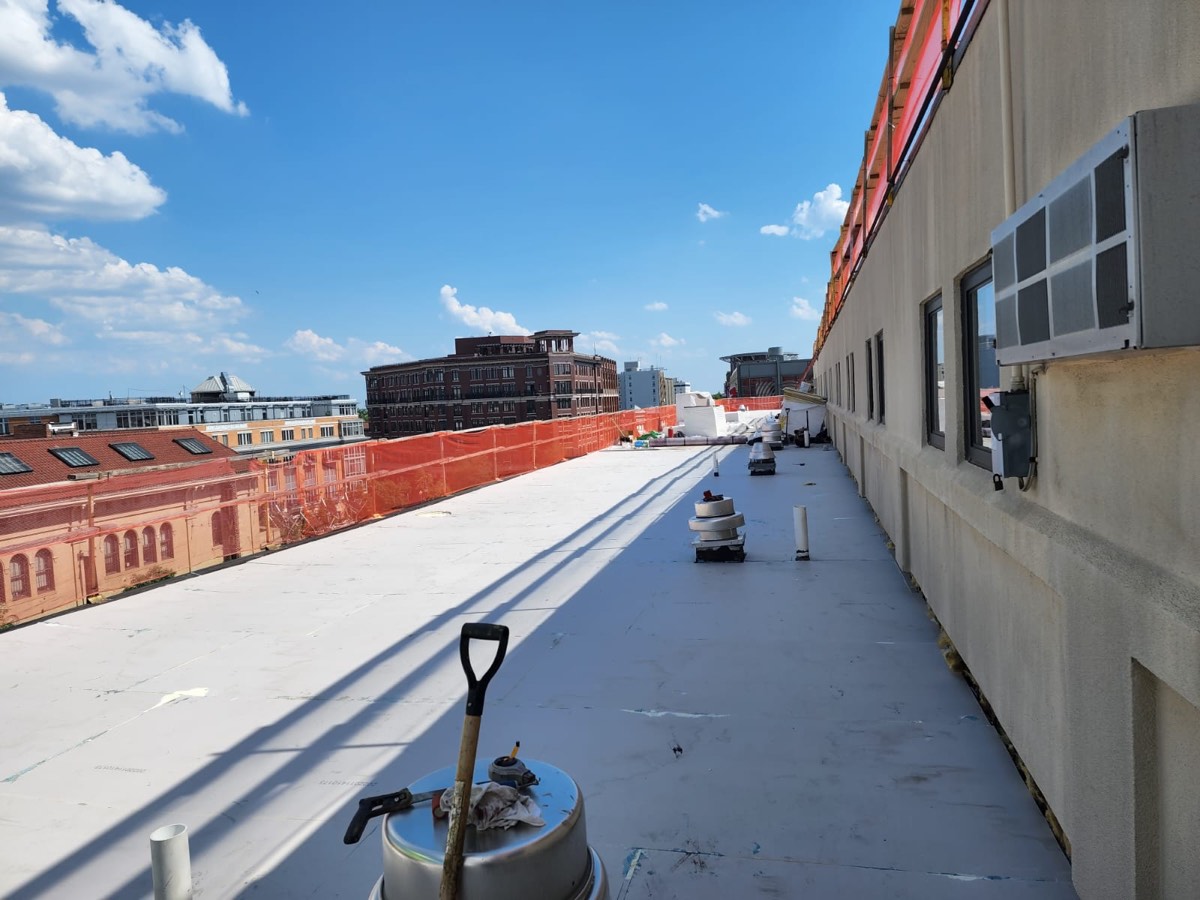
Commercial Roof Replacement in DC, Maryland & Virginia
Full replacement is the largest single line item most commercial buildings will spend on the envelope. Here is what actually drives the number, what the code forces, and how to tell a real scope from a thin one.
A roof replacement is three decisions stacked on top of each other: whether you tear off or recover, what insulation you have to add to satisfy the energy code, and which membrane you put on top. Most of the price difference between two bids on the same building comes from the first two, not the third — which is why comparing bids on membrane brand alone tells you almost nothing.
We work through those decisions in front of you, with the condition report as the starting point rather than a proposal you have to reverse-engineer.
Tear-off or recover — and who actually gets to choose
A recover leaves the existing roof in place and installs a new membrane over it. It is faster, cheaper, and produces almost no landfill. It is also not always legal.
IBC §1511 prohibits recovering when the existing roof already carries two or more applications of roof covering, or when the existing roof is water-soaked or deteriorated enough that it is no longer a sound base. If either is true, the code requires removal down to the deck. A core cut and a moisture survey settle the question in an afternoon; a bid that assumes recover without either is guessing with your money.
Recover works when there is one existing layer, the insulation below is dry, the deck is sound, and drainage is adequate.
Tear-off is required when there are already two layers, the insulation is saturated, the deck needs repair, or you need to rebuild slope.
Tear-off is usually smarter anyway when the roof is over about 25 years old — you inherit whatever is under a recover for the next 25 years.
The insulation is the hidden cost
The DMV is climate zone 4. Current commercial energy code calls for roughly R-30 continuous insulation above the deck on a low-slope roof. A building put up in the seventies or eighties commonly has half that or less.
Bringing the assembly up to code means adding several inches of polyiso, and that has knock-on effects: parapet heights, door thresholds, curb heights for rooftop equipment, and flashing terminations all move. Those adjustments are real work. When a bid is dramatically cheaper than the others, this is usually the section that is missing.
What a complete scope contains
Core cuts and a moisture survey establishing what is actually under the existing membrane
Tear-off and disposal, or a documented basis for recover under IBC §1511
Deck inspection with a stated unit price for repair or replacement
Insulation to the energy code requirement, with tapered where drainage needs correcting
Cover board where the membrane and manufacturer warranty call for one
Membrane with attachment specified by ASCE 7 roof zone — field, perimeter and corner called out separately
All flashings, curbs, penetrations, edge metal and coping detailed rather than "as required"
Mechanical equipment lift, curb re-flash and reset, coordinated with your HVAC vendor
Primary and secondary drainage verified against code, not assumed
Manufacturer warranty type, term and the inspection it requires to stay in force
What it costs
System
Installed cost / sq ft
Typical service life
Notes
TPO, mechanically attached
$9 – $16
20–30 yrs
Most common DMV replacement. Reflective, heat-welded seams.
TPO, fully adhered
$11 – $19
20–30 yrs
Quieter, better wind performance, no fastener pattern telegraphing.
EPDM, mechanically attached
$8.50 – $15
20–30 yrs
Proven on older stock. Black absorbs heat; ballast or white options exist.
EPDM, fully adhered
$10.50 – $18
25–30 yrs
Cleaner detailing around heavy penetration counts.
PVC single-ply
$11 – $19
20–30 yrs
Grease and chemical resistant — restaurants, kitchens, industrial exhaust.
Modified bitumen, 2-ply
$10 – $18
15–25 yrs
Tough underfoot. Good on small, complex, high-traffic roofs.
How to read these. Ranges are DMV market pricing for planning and budgeting, not a quote. Real numbers move with deck condition, insulation required to hit code, access and staging, how much rooftop mechanical equipment has to be lifted and reset, and whether the work is phased around tenants.
Code & compliance
The requirements below apply throughout the DMV. Jurisdiction specifics are on each service area page.
IBC Chapter 15 governs the assembly
Roof coverings, flashing, drainage and rooftop structures all live in Chapter 15 of the building code as adopted by your jurisdiction. §1511 is the section that controls reroofing specifically.
Energy code applies to replacement, not just new build
Replacing a roof triggers the insulation requirement for the new assembly. Recovering can sometimes avoid it depending on scope and jurisdiction — one more reason the tear-off-versus-recover call has cost consequences beyond labour.
Structural check when you add load
Adding insulation, ballast, pavers or a new mechanical unit adds dead load. On older buildings that can require a structural review before the permit issues.
The rule that decides most jobs: IBC §1511 prohibits a roof recover where the existing roof already has two or more applications of any roof covering. It also prohibits recovering when the existing roof is water-soaked or has deteriorated to the point that it is no longer an adequate base. In either case the code requires removal down to the deck. This is the single most common place a cheap bid quietly goes non-compliant.
Inspections & quality control
Deck inspection after tear-off, before insulation goes down — the one people most often cover too early.
In-progress inspection of the assembly and attachment.
Final inspection of the completed roof, flashings and drainage.
Manufacturer field inspection where an NDL or extended warranty is being issued — separate from the jurisdiction's inspection, and required for the warranty to activate.
Important things to know
Ask which of the three bids assumed a recover. If one did and the others did not, you are not comparing the same job.
Wet insulation left in place under a new membrane will show up as a leak within a few winters, and the warranty will not cover it.
Phasing around tenants costs more per square foot than an empty building. Say so up front so the bids reflect reality.
Schedule around the weather window, not the fiscal year. A roof opened in late November in the DMV is a gamble.
Questions we get
How long does a commercial roof replacement take?
A straightforward 20,000 sq ft low-slope roof is typically one to two weeks of production once materials land. Phased work on an occupied building, heavy mechanical coordination, or deck repair extends that. Weather delay is real here — we plan sections so the building is dried in every night.
Can you replace a roof while the building stays occupied?
Yes, and that is the normal case. Work is staged in sections so no part of the building is ever open overnight, material handling is scheduled around business hours, and tenant access routes are protected and marked.
Do I need a permit to replace a commercial roof?
In nearly every DMV jurisdiction, yes. Ordinary repair below the code threshold may be exempt, but a replacement or recover is not. The permit should be pulled in the contractor's name.
How much does it cost per square foot?
Most DMV commercial low-slope replacements land between $9 and $19 per square foot installed, depending on system, insulation required, deck condition and access. The condition report gives you a real range for your building rather than a national average.
Find out what your roof actually needs.
A 30-minute consultation, then a written report with photos and numbers. No obligation.
Pick a time that suits you. We'll talk through the building, walk the roof, and send you a written condition report with photos and budget ranges for repair, restoration and replacement.