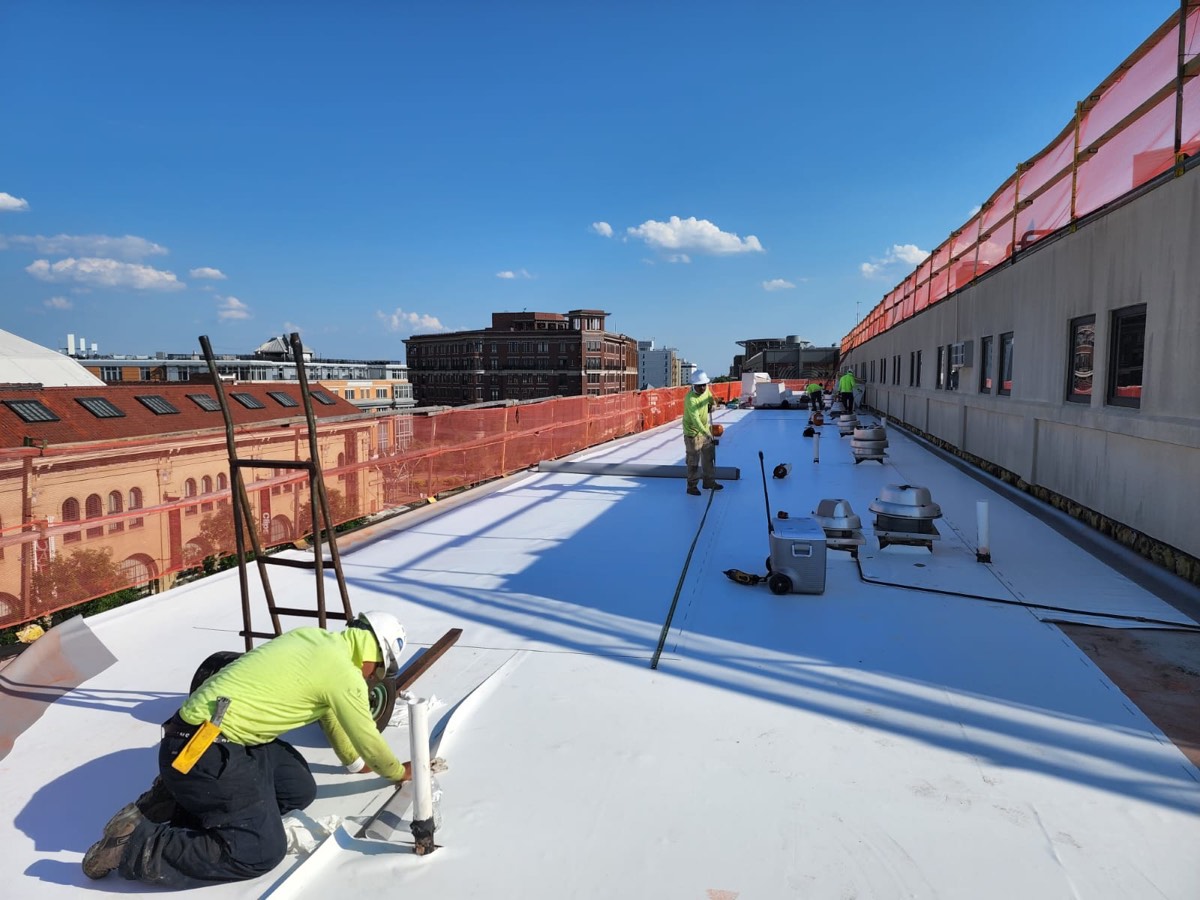
TPO is the default for most low-slope replacements in this region, and for good reasons — but only if it is specified properly. Thickness, attachment and seam quality separate a twenty-five year roof from a twelve year one.
Thermoplastic polyolefin is a single-ply membrane with heat-welded seams. Welded seams are the reason it performs: done right, the seam is as strong as the sheet, which is not true of adhesive-lapped systems.
Its reflectivity also matters here. A white membrane on a DC-area rooftop meaningfully lowers the surface temperature and takes load off rooftop HVAC, which is a real operating-cost argument on top of the roofing one.
Specify the thickness, not just the product
TPO comes in 45, 60 and 80 mil. Sixty mil is the sensible commercial baseline in the DMV; 45 mil belongs on light-duty roofs with almost no foot traffic, and it is the thickness a low bid quietly substitutes. Eighty mil is worth the money where there is regular service traffic to mechanical equipment.
Thickness also drives the warranty available. Most manufacturers will not issue their longest term on 45 mil.
Mechanically attached, fully adhered or induction welded
Mechanically attached — fasteners and plates through the membrane into the deck. Fastest and cheapest, and fine on most buildings. Fastener rows can telegraph, and the membrane flutters in high wind.
Fully adhered — bonded across the whole surface. Better wind performance, flatter appearance, quieter interior. Costs more and needs a clean, dry substrate.
Induction welded — plates fastened to the deck, membrane welded to the plates from above. No penetrations through the sheet, adhered-like performance at closer to mechanically attached cost.
Where TPO roofs actually fail
Not usually in the field of the sheet. Failures cluster at details: seams that were welded cold or too fast, terminations at parapets and curbs, pipe boots that were never replaced, and drains where the membrane was never properly clamped.
That is why we probe seams during installation rather than only at the end, and why the condition report on an existing TPO roof spends most of its time at the edges.
What it costs
System
Installed cost / sq ft
Typical service life
Notes
TPO, mechanically attached
$9 – $16
20–30 yrs
Most common DMV replacement. Reflective, heat-welded seams.
TPO, fully adhered
$11 – $19
20–30 yrs
Quieter, better wind performance, no fastener pattern telegraphing.
How to read these. Ranges are DMV market pricing for planning and budgeting, not a quote. Real numbers move with deck condition, insulation required to hit code, access and staging, how much rooftop mechanical equipment has to be lifted and reset, and whether the work is phased around tenants.
Code & compliance
The requirements below apply throughout the DMV. Jurisdiction specifics are on each service area page.
Fire classification
The roof assembly, not just the membrane, has to carry the required fire classification. That is an assembly listing — membrane, cover board and insulation together — and it should be named in the submittal.
Wind uplift by zone
Fastener spacing must tighten at perimeters and corners per ASCE 7. On a mechanically attached TPO roof this is the single most important thing to verify in a bid.
Cover board
Most manufacturers require a cover board over polyiso for their longer warranties, and it materially improves puncture resistance under foot traffic. It is a common deletion in cut-price bids.
The rule that decides most jobs: IBC §1511 prohibits a roof recover where the existing roof already has two or more applications of any roof covering. It also prohibits recovering when the existing roof is water-soaked or has deteriorated to the point that it is no longer an adequate base. In either case the code requires removal down to the deck. This is the single most common place a cheap bid quietly goes non-compliant.
Inspections & quality control
Seam probing during installation, not just at completion.
Fastener pull tests to confirm the deck holds the specified pattern.
Jurisdiction in-progress and final inspection.
Manufacturer field inspection where an NDL warranty is being issued.
Important things to know
TPO formulations changed substantially after the early-generation products of the 2000s. Older horror stories are mostly about membranes that are no longer sold.
White membranes get dirty. That is cosmetic, not performance — but it is worth setting the expectation with a board before the first spring.
If a bid does not state mil thickness, assume 45 mil.
Grease exhaust destroys TPO. Restaurants and commercial kitchens should be looking at PVC instead.
Questions we get
How long does a TPO roof last in the DMV?
A properly specified 60 mil TPO roof with a cover board and correctly detailed edges should give twenty to thirty years here. Thin membrane, no cover board and heavy untreated foot traffic pull that down sharply.
Is TPO better than EPDM?
Neither is better in the abstract. TPO gives you welded seams and reflectivity; EPDM gives you a long, boring track record and easier detailing around dense penetrations. The building decides — how much rooftop equipment, how much foot traffic, what the HVAC load looks like.
Can TPO go over my existing roof?
Sometimes. If there is only one existing layer, the insulation is dry and the deck is sound, a recover is legitimate. If there are already two layers or the insulation is wet, the code requires tear-off.
Find out what your roof actually needs.
A 30-minute consultation, then a written report with photos and numbers. No obligation.
Pick a time that suits you. We'll talk through the building, walk the roof, and send you a written condition report with photos and budget ranges for repair, restoration and replacement.