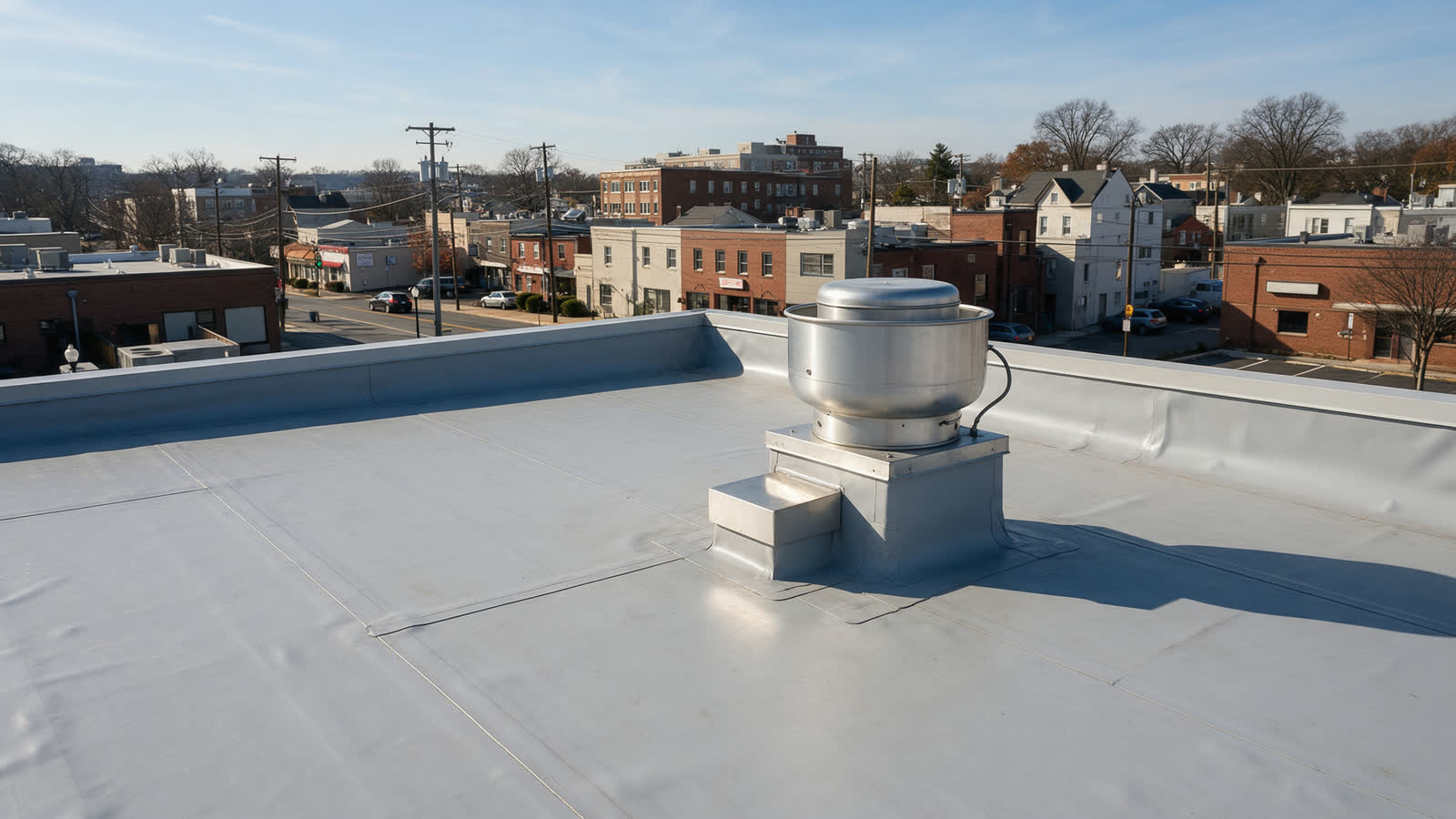
Commercial PVC Roofing in the DMV
If your roof has kitchen exhaust, chemical discharge or industrial fume on it, PVC is not the upgrade option — it is the correct specification.
If your roof has kitchen exhaust, chemical discharge or industrial fume on it, PVC is not the upgrade option — it is the correct specification.
PVC is a heat-welded single-ply like TPO, but the chemistry is different in a way that matters: it resists animal fats, grease and many industrial chemicals that will break down other membranes.
That makes it the default for restaurants, commercial kitchens, food processing, and buildings with heavy exhaust — and an expensive over-specification for a plain office roof with nothing on it.
Like TPO, PVC is hot-air welded and the seam is only as good as the technician and the weather. Probe testing during installation is not optional.
PVC is also more dimensionally stable than TPO over time, which shows up as less stress on terminations and corners over a long service life.
PVC is not compatible with asphalt-based products or with polystyrene insulation in direct contact — it needs a separation layer. This is not exotic knowledge, but it is the sort of detail that gets missed when a crew that mostly installs TPO takes a PVC job.
| System | Installed cost / sq ft | Typical service life | Notes |
|---|---|---|---|
| PVC single-ply | $11 – $19 | 20–30 yrs | Grease and chemical resistant — restaurants, kitchens, industrial exhaust. |
How to read these. Ranges are DMV market pricing for planning and budgeting, not a quote. Real numbers move with deck condition, insulation required to hit code, access and staging, how much rooftop mechanical equipment has to be lifted and reset, and whether the work is phased around tenants.
The requirements below apply throughout the DMV. Jurisdiction specifics are on each service area page.
The mechanical code governs kitchen exhaust termination — height above the roof, clearance to intakes and to property lines. A roof replacement is a good moment to fix a non-compliant exhaust that has been quietly cooking your membrane.
As with any membrane, the classification belongs to the assembly. Name it in the submittal.
Where PVC meets asphalt-based existing roofing or polystyrene, a separator is required. Confirm it is in the scope.
The rule that decides most jobs: IBC §1511 prohibits a roof recover where the existing roof already has two or more applications of any roof covering. It also prohibits recovering when the existing roof is water-soaked or has deteriorated to the point that it is no longer an adequate base. In either case the code requires removal down to the deck. This is the single most common place a cheap bid quietly goes non-compliant.
On a building with grease or chemical exhaust, unambiguously yes — TPO will not survive it. On a clean office or warehouse roof with no exhaust, the premium usually is not justified.
Twenty to thirty years is a reasonable expectation for a well-detailed PVC roof in this climate, and it holds up better than most membranes in the specific conditions it is chosen for.
Not in direct contact. PVC and asphalt-based materials are incompatible, so a separation layer or a tear-off is required — and if there are already two layers up there, the code settles it: tear-off.
A 30-minute consultation, then a written report with photos and numbers. No obligation.
Pick a time that suits you. We'll talk through the building, walk the roof, and send you a written condition report with photos and budget ranges for repair, restoration and replacement.
Opens our live calendar. Pick a time — there is no form to fill in.
Active leak? Don't book — call 202-798-7663. We triage leaks ahead of scheduled visits.