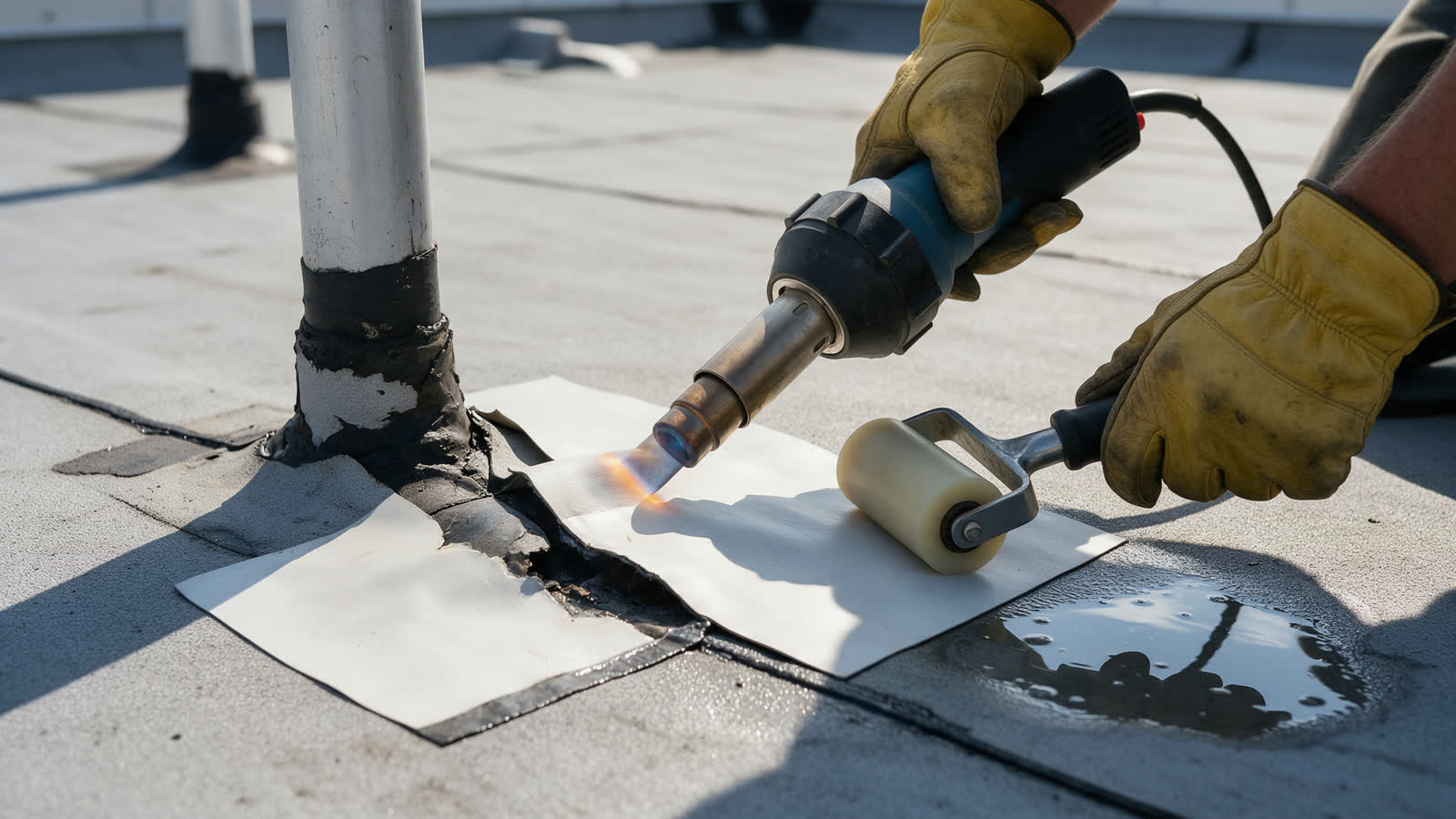
On a low-slope roof, water enters at a defect, travels along the deck or through the insulation, and appears somewhere else entirely. That is why chasing stains produces contractors who have "fixed" the same leak four times.
We investigate first. If we cannot show you where the water is getting in, we have not earned the repair.
A single defect with dry insulation around it is a repair, and it should be cheap. Multiple defects across the field, or wet insulation spreading well beyond the visible problem, means the roof is failing rather than damaged.
The honest version of that conversation is worth more to you than another patch. If we think you are spending good money on a roof that needs replacing, we will say so and show you the survey that says why.
Active leaks get triaged ahead of assessments. The first move is stopping water entering the building — temporary dry-in, tarping, plugging — followed by a permanent repair once conditions allow.
What you can do before we arrive: move what you can out from under it, put containment down, photograph everything for your insurer, and do not send anyone onto a wet roof.
| Item | Typical range | Notes |
|---|---|---|
| Leak investigation and repair | $500 – $5,000 | Most single-source leaks land in the low four figures. Chronic leaks need a survey, not a patch. |
| Infrared or moisture survey | $0.05 – $0.15 / sq ft | Maps wet insulation so you replace only the saturated area instead of the whole field. |
| Preventive maintenance program | $0.08 – $0.20 / sq ft / yr | Two inspections a year plus minor repairs. Usually required to keep an NDL warranty alive. |
| Tapered insulation for drainage | $2 – $5 / sq ft (added) | Where ponding has to be corrected rather than lived with. |
| Deck replacement | $6 – $14 / sq ft (added) | Only discovered once the old roof is off. Should be a unit price in your contract, not a change order fight. |
How to read these. Ranges are DMV market pricing for planning and budgeting, not a quote. Real numbers move with deck condition, insulation required to hit code, access and staging, how much rooftop mechanical equipment has to be lifted and reset, and whether the work is phased around tenants.
The requirements below apply throughout the DMV. Jurisdiction specifics are on each service area page.
Codes carve out ordinary repair, which is why a patch does not normally need a permit. Where the "repair" becomes a partial replacement or changes the assembly, it does.
Once a roof needs recovering or replacing, IBC §1511 governs — and if there are already two layers up there, patching is delaying an inevitable tear-off.
Storm-related damage has to be documented at the time to be claimable later. Photographs, dates and a written condition assessment are what an adjuster will ask for.
The rule that decides most jobs: IBC §1511 prohibits a roof recover where the existing roof already has two or more applications of any roof covering. It also prohibits recovering when the existing roof is water-soaked or has deteriorated to the point that it is no longer an adequate base. In either case the code requires removal down to the deck. This is the single most common place a cheap bid quietly goes non-compliant.
Almost always because they are repairing where the water appears rather than where it enters. On a low-slope roof water travels a long way through the assembly. Without a moisture survey or water testing you are patching a guess.
Most single-source repairs land between $500 and $5,000. Chronic or multi-point leaks need investigation first — an infrared survey typically runs $0.05 to $0.15 per square foot and tells you whether you have a repair or a failing roof.
Call 202-798-7663 and we will tell you honestly when we can be there. Active leaks are triaged ahead of scheduled assessments, and we will talk you through protecting the interior in the meantime.
A 30-minute consultation, then a written report with photos and numbers. No obligation.
Pick a time that suits you. We'll talk through the building, walk the roof, and send you a written condition report with photos and budget ranges for repair, restoration and replacement.
Opens our live calendar. Pick a time — there is no form to fill in.
Active leak? Don't book — call 202-798-7663. We triage leaks ahead of scheduled visits.