A flat roof is only as good as the few holes that let water off it. When one of those holes is half full of leaves, the roof is still doing its job. It is just doing it more slowly, while more water and more weight build up on it. Commercial roof drain maintenance is the cheapest roof protection a facility team can provide, and almost all of it is housekeeping, not roofing.
Below: the seasonal routine, how to read an overflow that has run, and where the job passes to a roofer or plumber.
How a commercial roof sheds water
Most low-slope roofs in the DMV drain one of three ways, and many use a mix:
Why a partly blocked drain matters more than it looks
A drain does not need to be fully clogged to cause trouble. Laboratory testing published by roof consultant Jim Koontz in IIBEC Interface (December 2013) measured how much water builds up around a drain as debris covers its inlet:
Those are test-rig numbers, not your roof, but the pattern holds: the last quarter of blockage does far more harm than the first. Every extra inch adds weight to the deck and pushes water higher up flashings and seams.
The same study found that ice in a 6-in. drain nearly doubled the water depth at the test flow, from 3.25 to 6 inches. Leaves left in a drain in November become an ice plug in January.
What the code expects (and why overflows exist)
Roof drainage design falls under the International Plumbing Code (IPC), as adopted locally. The 2021 IPC as adopted in Virginia is a good example of the requirements:
- §1101.7 — roof design. Roofs must be designed for the deepest water that can pond on them, assuming all primary drains are blocked. The structure is designed on the expectation that primaries will sometimes clog.
- §1108.1 — when overflows are required. Where a parapet or other perimeter construction would trap water if the primary drains backed up, secondary (emergency overflow) drains or scuppers are required.
- §1108.2 — separate, visible discharge. The overflow system must discharge separately from the primary system, above grade, in a place building occupants would normally see.
Adoption varies. DC works from its 2017 construction codes (2015 ICC base), administered by the Department of Buildings. In Montgomery and Prince George's counties, plumbing falls under WSSC Water's own code, which is built on the IPC with local amendments. WSSC proposed moving to the 2021 IPC in 2022, so check its codebooks page for the edition in force. Elsewhere in Maryland and Virginia, ask the county permit office.
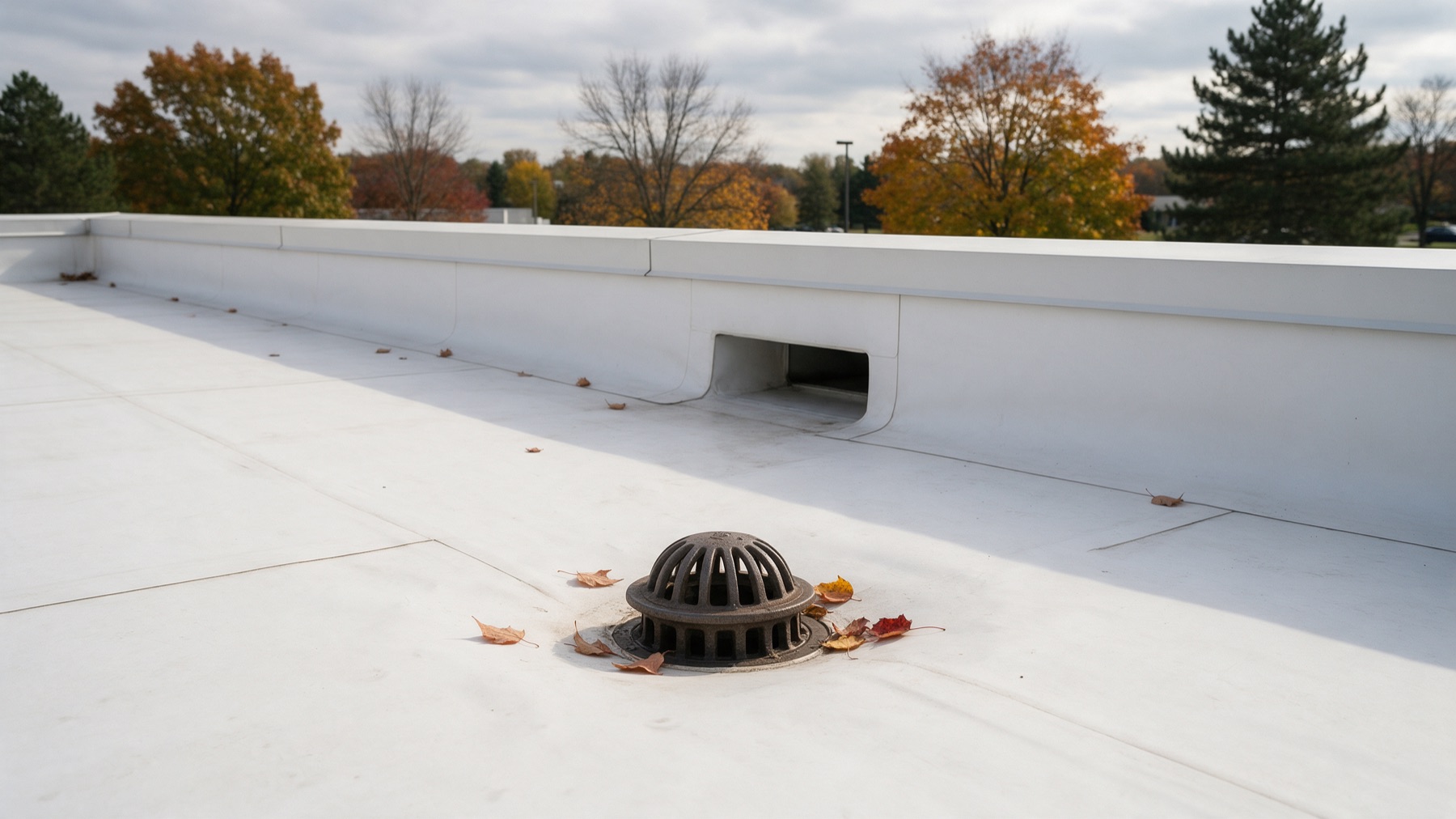
What this means for a facility team: an overflow scupper or downspout that is running is an alarm. The code puts it where people will see it on purpose. If water comes out of it, the primary drain on that part of the roof is probably blocked or undersized, and the roof is carrying more water than it should.
The seasonal drain routine
Spring, fall, and after any storm that brings down leaves or branches.
Before anyone goes on the roof
If staff go onto the roof, OSHA's low-slope rules in 29 CFR 1910.28(b)(13) apply. Within 6 feet of an edge, fall protection is required. From 6 to 15 feet, you need protection, or a designated area for work that is both infrequent and temporary. Beyond 15 feet, you need protection, a designated area or an enforced rule keeping people back from the edge. Skylights count as holes. Our fall roof maintenance checklist has the full table. Never go up alone, and never on a wet, frosty, snowy or windy day.
Scuppers are in the parapet, which puts them at the edge. Your team checks them from 15 feet back or from the ground. They do not walk up to them.
Interior drains in the field of the roof
- Lift debris off and around the strainer dome by hand, with gloves, and bag it. Don't sweep it towards the drain.
- Check the dome is there and seated. A missing dome lets leaves, bottles and gravel straight into the pipe, where they cost a plumber's visit to remove.
- Look, don't probe. Note any split or lifted membrane at the drain flange and photograph it. Don't cut, seal or pry anything.
- Don't push a hose, rod or snake down the drain. Clearing the line below the roof is a plumber's job. Forcing tools past the drain body can damage the clamping ring and the membrane seal.
- Photograph each drain from the same spot every visit and number it on a roof plan.
Scuppers, gutters and downspouts — from the ground
- Look at the scupper outlet and conductor head from the ground. Plants growing out of it, or a mat of leaves, means it is blocked.
- Check downspouts. They should be attached, uncrushed and discharging away from the foundation, and nothing should be stacked against the outlet.
- Find the overflow outlets and label them, so staff know which outlets are emergency overflows and that water coming out of them is not normal.
- Look for streaks below overflow outlets: the overflow has been working, even if nobody saw it.
During and after heavy rain
From inside, or from the ground under cover, watch for:
What your team should not do
- Never block, plug or "tidy" an overflow. Don't screen it so tightly that leaves mat over it, don't store things in front of it, and never cap it because it "leaks". It is meant to run when the primary drain can't keep up.
- Never pump or squeegee water off a roof yourself. Moving water towards an edge puts people at the edge, and standing water on a deck that may be overloaded is a structural question.
- Leave roof drain bodies and piping to licensed trades. Replacing a drain, clamping ring or leader is roofing and plumbing work.
When it becomes a roofer's job
Call a roofer, and a plumber where noted, when:
- An overflow has run, or the staining below it shows it has been running
- Water is still on the roof 48 hours after rain in drying weather
- A drain is clear at the strainer but still slow (call the plumber about the line, and the roofer about the flange)
- A strainer dome is missing, broken, or the clamping ring is loose
- Membrane at a drain is split, lifted or patched with sealant
- A scupper, conductor head or gutter is rusted through, separated or crushed
- You are planning a reroof. That is the time to ask whether drain count, size and overflow capacity still suit the roof.
Drain and flange problems are commercial roof repair work. A roof maintenance program puts the drain clean-out on a schedule with photos, the kind of record a manufacturer may ask for if you ever make a warranty claim. If ponding keeps coming back across a whole section, the honest answer may be tapered insulation or extra drains during a roof replacement, not more cleaning.
FAQ
How often should commercial roof drains be cleaned?
At least spring and fall, and after any storm that brings down leaves or branches. Roofs under trees often need a visit every month or two in autumn.
Water is coming out of our overflow scupper — is that a leak?
No. It is the backup doing its job, and it usually means the primary drain on that part of the roof is blocked or overwhelmed. Log the date and time, then get the primary drain checked soon.
Can our maintenance staff snake a clogged roof drain?
Clearing the strainer is housekeeping. Snaking or jetting the line is a plumber's job; forcing tools through the drain body can damage the membrane seal.
Do we need overflow drains if our roof has no parapet?
Under IPC §1108.1, overflows are required where perimeter construction would trap water if the primary drains backed up. If water can spill freely off the edge, the requirement may not apply. Check with your local permit office and design professional.
If an overflow has been running, or water stands on your roof longer than it should, book a free 30-minute consultation or call 202-798-7663. Bring your drain photos and we'll tell you what they show.
Header image: AI-generated illustration (Magnific).