Fairfax has the largest commercial office inventory in Northern Virginia, and a very large share of it was built in one twenty-year window. Those roofs are all coming due together.
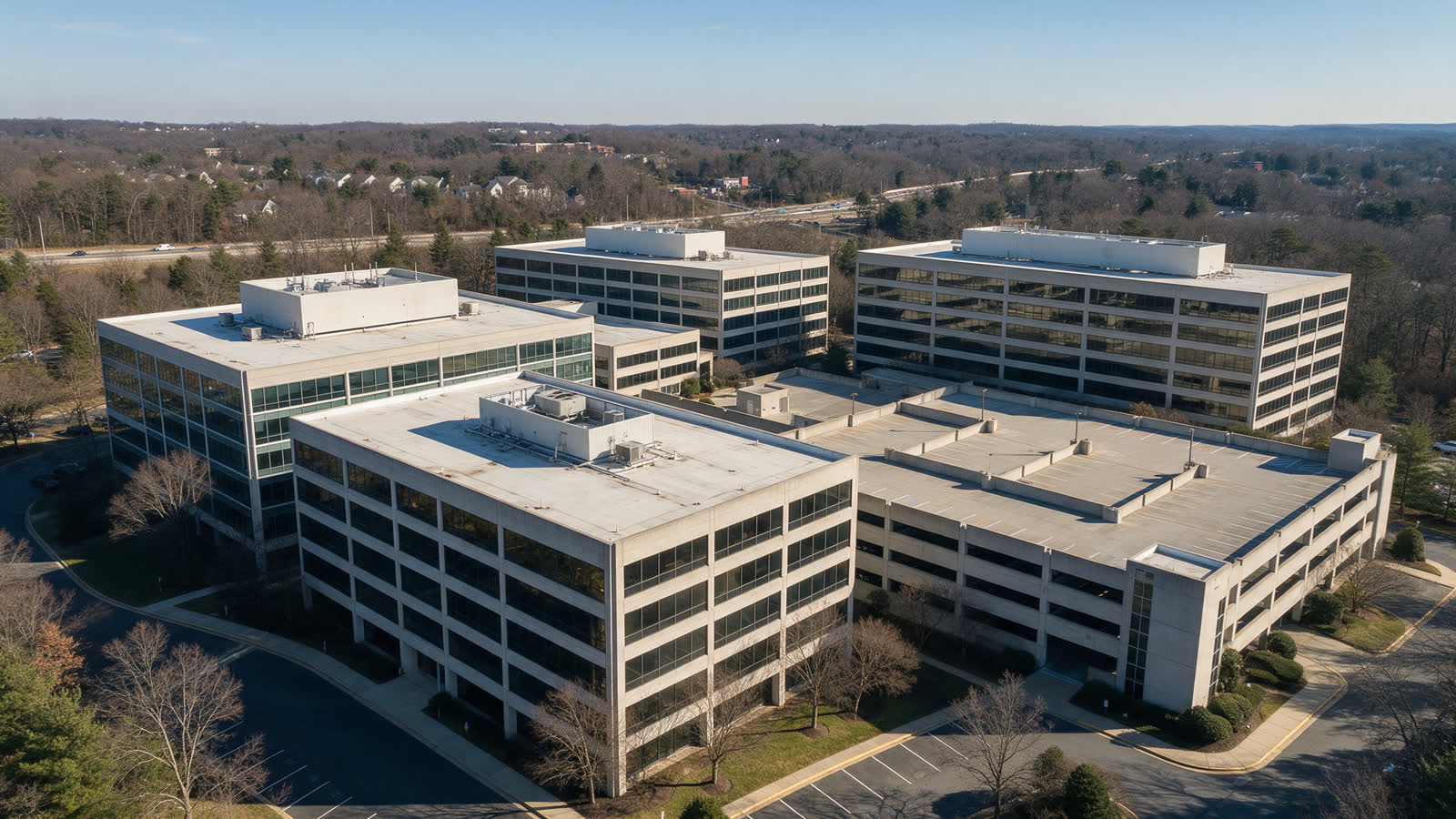
Tysons, Reston, Merrifield, Herndon and the Dulles corridor carry an enormous stock of 1980s and 1990s office and flex buildings, plus newer mixed-use towers, hotels, data and telecom facilities and extensive retail.
The 1980s-90s buildings are the story. They are on their second roof, they were insulated to a standard well below what the energy code now requires, and many of them are being repositioned — new tenants, new rooftop equipment, new mechanical load on a deck designed for less. A roof replacement on one of these is rarely just a roof replacement.
Permits & who issues them
Permits are issued locally, but the code being enforced is the same everywhere in the Commonwealth.
A building permit is required for commercial reroofing under the USBC. Ordinary repair below the code's threshold is exempt, but replacement, recover and any change to the assembly are not.
Pull it in the roofer's name. If a contractor asks you to take the permit out as the owner, they are moving liability for the work onto you. That is a reason to pick someone else.
The building code in force
Virginia enforces the Uniform Statewide Building Code. The 2021 USBC took effect January 18, 2024, with a one-year transition during which either the 2018 or 2021 technical provisions could be used; the 2021 edition stands alone now. Because the USBC is a statewide regulation, localities cannot make the technical requirements more stringent — what differs across Northern Virginia is process and turnaround, not the code.
You get two roofs, then you tear off
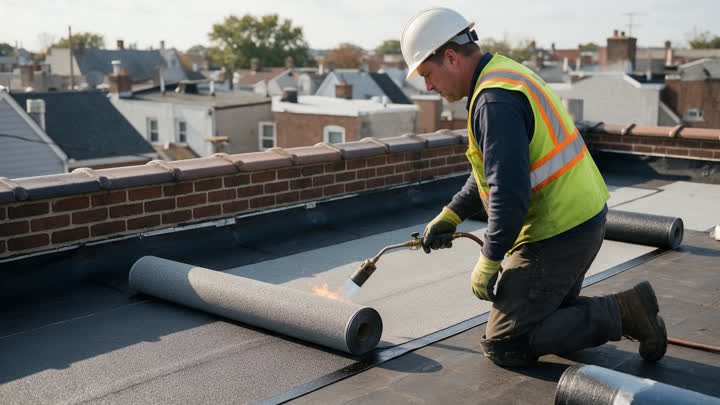
IBC §1511 prohibits a roof recover where the existing roof already has two or more applications of any roof covering. It also prohibits recovering when the existing roof is water-soaked or has deteriorated to the point that it is no longer an adequate base. In either case the code requires removal down to the deck. This is the single most common place a cheap bid quietly goes non-compliant.
Energy code drives the insulation, and the insulation drives the price
The DMV sits in climate zone 4. For low-slope roofs with insulation entirely above the deck, the IECC commercial table calls for roughly R-30 continuous. On an older building that was built with two inches of insulation, meeting that number is frequently the largest single line item in a replacement — and the reason a tear-off costs meaningfully more than the recover somebody quoted you.
Edges and corners are not the field
Wind uplift concentrates at perimeters and corners, and ASCE 7 requires tighter attachment in those zones. A bid that specifies one fastening pattern for the whole roof is either an oversight or a shortcut. Ask to see the zones called out.
Drainage is a code item, not a preference
Roofs need primary drainage plus a secondary (overflow) path sized so a blocked primary drain does not load the structure with standing water. On replacements we look at whether existing overflow scuppers are present and correctly set — on older DMV buildings they often are not.
Local rules that actually change the job
Land Development Services
Commercial building permits, plan review and inspections run through Fairfax County Land Development Services, enforcing the 2021 Virginia USBC. Fairfax handles a very high volume, and its published process and permit library are more navigable than most — but plan review queues on larger submissions are real and should be in your schedule.
Repositioning drives roof scope
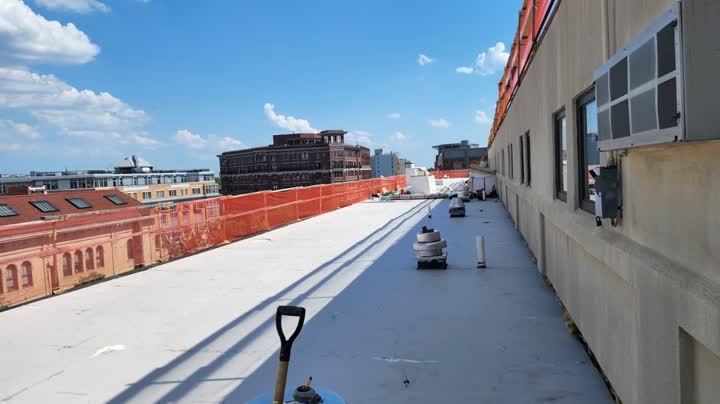
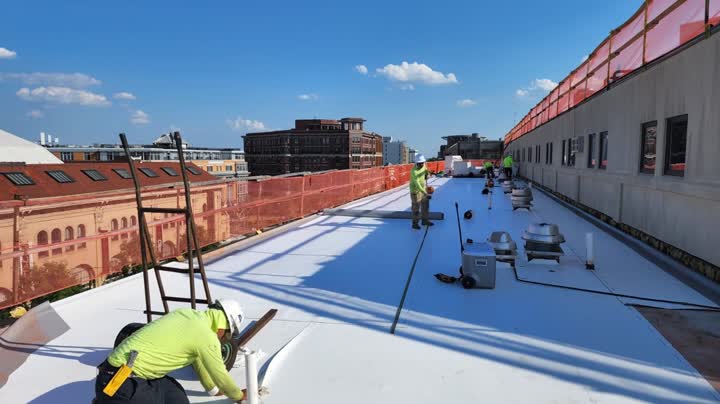
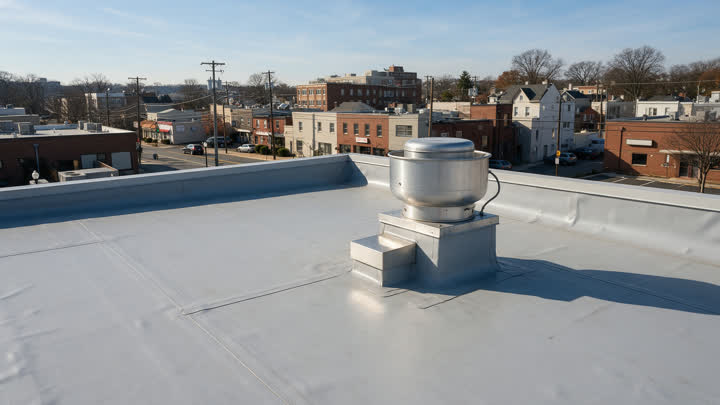
When an office building is repositioned for a new tenant mix, the roof usually gains equipment: new RTUs, exhaust for food service, telecom, sometimes solar. Each of those is dead load, a curb, and a set of penetrations. Doing the roof and the equipment changes as one coordinated scope is dramatically cheaper than doing them a year apart and cutting new penetrations into a new membrane.
Energy code on tear-off
The 2021 USBC brings the current energy provisions with it. On a 1985 office building with two inches of insulation, meeting the requirement on a full tear-off is a significant cost and a design change at parapets, thresholds and curb heights. It is also the thing that most often separates a realistic bid from a fantasy one.
Solar-ready and rooftop solar
Solar arrays are increasingly proposed on these large roofs. The rule that matters: put the array on a roof with twenty years of life left, never on one with five. Sequencing solar onto an aged roof means paying to remove and reinstall the array when the membrane fails. If solar is on the horizon, the roof goes first.
Inspections
The local building department inspects to the USBC — typically the deck or nailing stage and a final. Because the technical standard is uniform, an inspector in Loudoun and one in Alexandria are reading the same book; the difference you feel is scheduling and plan-review queue.
Deck inspection after tear-off, before anything covers it.
In-progress inspection of the assembly and attachment pattern.
Final inspection of the completed roof, flashings and drainage.
Manufacturer field inspection where an NDL or extended warranty is being issued — separate from the jurisdiction, and required for the warranty to activate.
What commercial roofing costs here
System
Installed cost / sq ft
Typical service life
Notes
TPO, mechanically attached
$9 – $16
20–30 yrs
Most common DMV replacement. Reflective, heat-welded seams.
TPO, fully adhered
$11 – $19
20–30 yrs
Quieter, better wind performance, no fastener pattern telegraphing.
EPDM, mechanically attached
$8.50 – $15
20–30 yrs
Proven on older stock. Black absorbs heat; ballast or white options exist.
EPDM, fully adhered
$10.50 – $18
25–30 yrs
Cleaner detailing around heavy penetration counts.
PVC single-ply
$11 – $19
20–30 yrs
Grease and chemical resistant — restaurants, kitchens, industrial exhaust.
Modified bitumen, 2-ply
$10 – $18
15–25 yrs
Tough underfoot. Good on small, complex, high-traffic roofs.
Built-up (BUR), 3–4 ply
$11 – $20
20–30 yrs
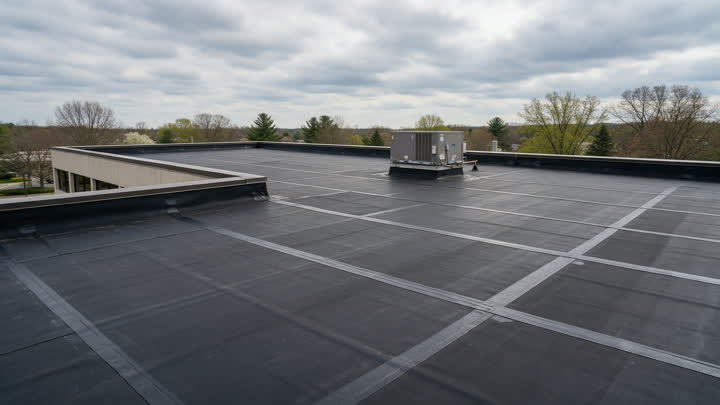
Rare as new work now; mostly repaired or overlaid.
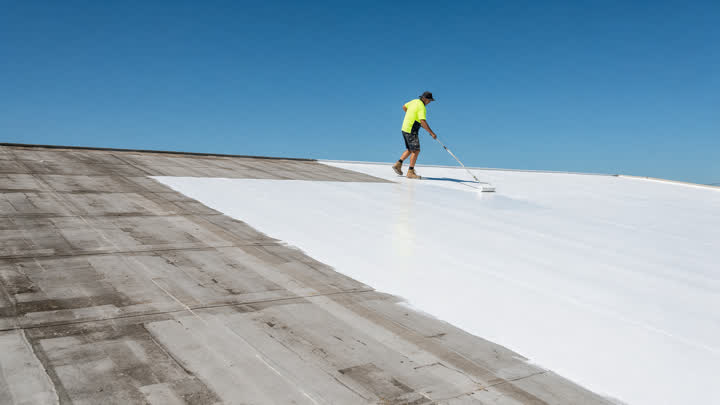
Silicone restoration coating
$3.50 – $7
10–20 yrs
Only over a sound, dry substrate. Renewable warranty at end of term.
Metal retrofit / recover
$12 – $25
30–40 yrs
Wide range — standing seam over purlins vs. coating an existing panel roof.
How to read these. Ranges are DMV market pricing for planning and budgeting, not a quote. Real numbers move with deck condition, insulation required to hit code, access and staging, how much rooftop mechanical equipment has to be lifted and reset, and whether the work is phased around tenants.
Investigation, maintenance and the things that get discovered
Item
Typical range
Notes
Leak investigation and repair
$500 – $5,000
Most single-source leaks land in the low four figures. Chronic leaks need a survey, not a patch.
Infrared or moisture survey
$0.05 – $0.15 / sq ft
Maps wet insulation so you replace only the saturated area instead of the whole field.
Preventive maintenance program
$0.08 – $0.20 / sq ft / yr
Two inspections a year plus minor repairs. Usually required to keep an NDL warranty alive.
Tapered insulation for drainage
$2 – $5 / sq ft (added)
Where ponding has to be corrected rather than lived with.
Deck replacement
$6 – $14 / sq ft (added)
Only discovered once the old roof is off. Should be a unit price in your contract, not a change order fight.
How to read these. Ranges are DMV market pricing for planning and budgeting, not a quote. Real numbers move with deck condition, insulation required to hit code, access and staging, how much rooftop mechanical equipment has to be lifted and reset, and whether the work is phased around tenants.
Important things to know in Fairfax County, Virginia
If solar is anywhere in your five-year plan, replace the roof before the array goes up. This is the most expensive sequencing mistake in commercial roofing.
Coordinate roof replacement with planned HVAC replacement. Lifting and resetting equipment once instead of twice saves real money.
The USBC is statewide — technical requirements in Fairfax match Arlington and Loudoun. Differences you experience are queue and process.
On 1980s buildings, verify the deck type before specifying. Lightweight insulating concrete decks behave very differently from steel and change the attachment method entirely.
And everywhere in the DMV
Get the permit in the contractor's name. If a roofer asks you to pull it as the owner, they are moving liability onto you.
Ask for the unit price on wet insulation and deck replacement before the contract is signed. Those are the two things nobody can see until the roof is open, and they are where an honest job and a bad one diverge.
A manufacturer NDL warranty is issued to the building, not to the contractor — but it usually requires a certified installer and documented maintenance. Confirm both before you rely on it.
Photograph the roof before work starts, including the mechanical equipment. It settles most disputes about who damaged what.
Questions we get
Who issues commercial roofing permits in Fairfax County?
Land Development Services handles commercial building permits, plan review and inspections, enforcing the 2021 Virginia Uniform Statewide Building Code.
Should we install solar before or after replacing the roof?
The roof first, always, unless it has twenty-plus years of life left. Installing an array over an aged membrane means paying to dismantle and reinstall it when the roof fails — frequently more than the roof replacement itself.
Our building is from 1988 — will we have to add insulation?
On a full tear-off, almost certainly. Current energy code calls for roughly R-30 continuous above deck in this climate zone, and buildings of that era typically have far less. It affects cost, parapet and curb heights, and door thresholds, so it belongs in the design conversation early.
What does commercial roofing cost in Fairfax County?
Most low-slope replacements run $9 to $18 per square foot installed. Tysons and Reston mid- and high-rise work sits at the upper end for access and staging; suburban flex and warehouse at the lower end.
Pick a time that suits you. We'll talk through the building, walk the roof, and send you a written condition report with photos and budget ranges for repair, restoration and replacement.
 VA
VA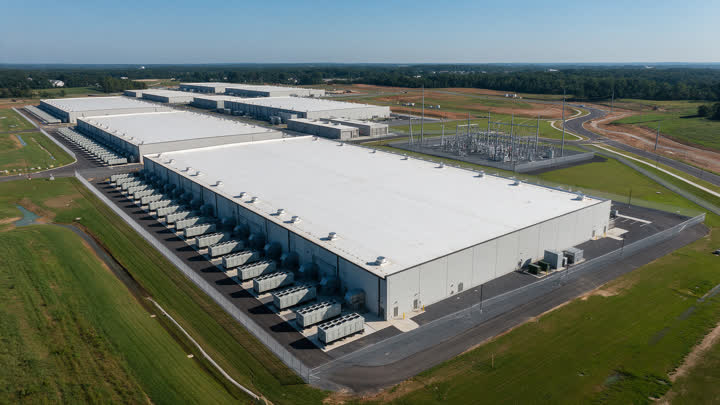 VA
VA VA
VA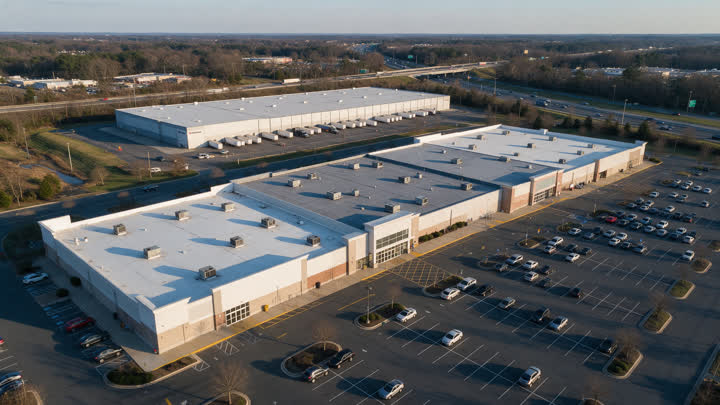 VA
VA