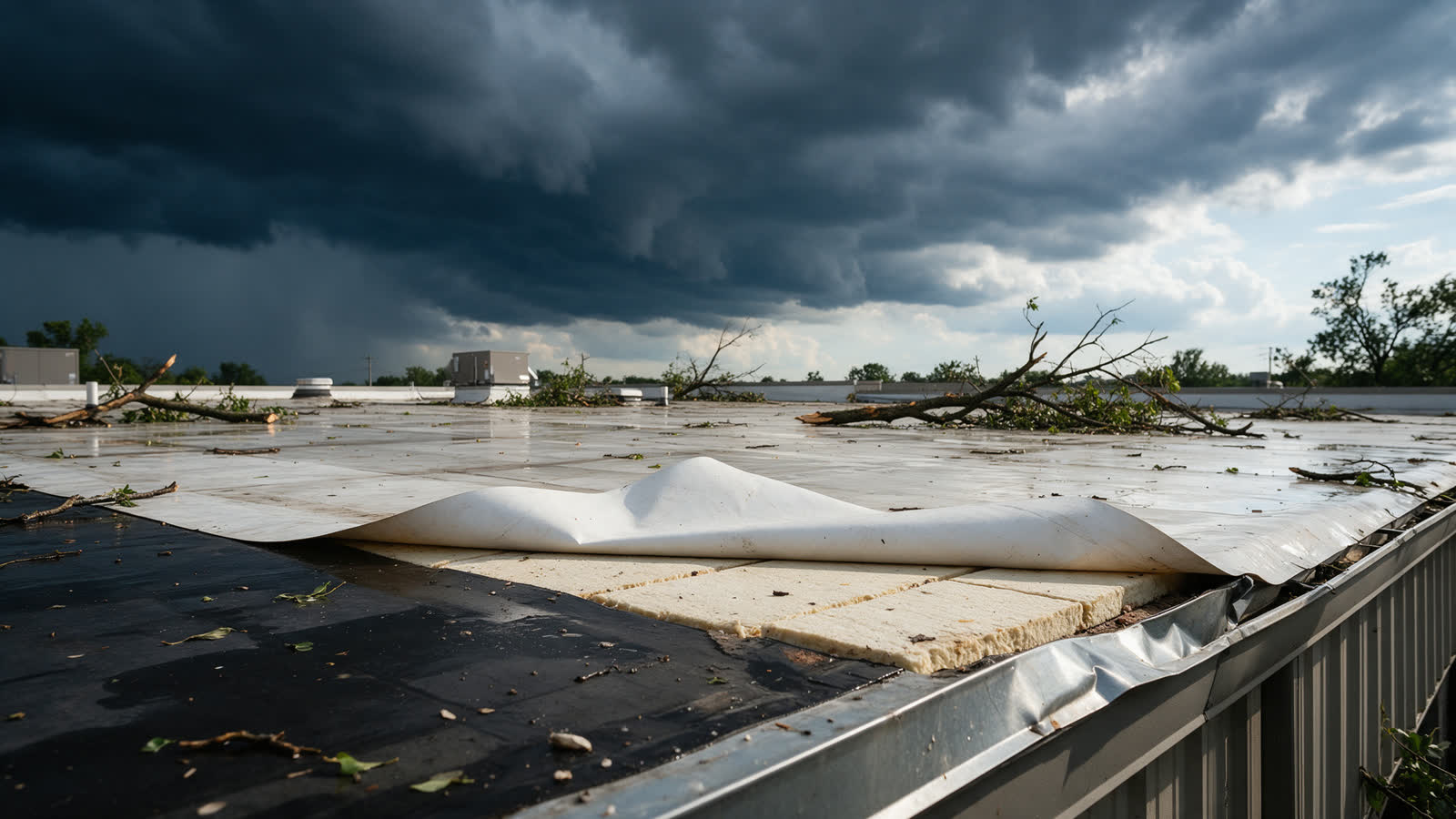
The DMV does not get hurricanes often, but it gets straight-line wind, hail, and the freeze-thaw cycles that turn a minor defect into an opening. Commercial policies generally cover sudden storm damage; they generally do not cover deterioration.
The line between those two is drawn by evidence. That is the part we can help with, and the part that has to happen immediately.
Adjusters are looking for storm-consistent damage: uplifted or displaced membrane, torn flashings, punctures with impact signatures, wind-scoured edge metal, damaged equipment. What they will push back on is anything that looks like age.
A credible report distinguishes the two rather than blurring them — it says what is storm damage, what is pre-existing, and what is arguable. That honesty is what makes the storm-damage portion stick.
After every significant weather event, out-of-state crews work the DMV knocking on commercial doors. Some are legitimate. Many will have you sign a contingency agreement or an assignment of benefits that hands them control of your claim, then disappear when the adjuster pushes back.
Two rules: never sign an assignment of benefits without your own counsel reading it, and never let anyone onto your roof who cannot show you a local licence and current certificates of insurance.
| Item | Typical range | Notes |
|---|---|---|
| Leak investigation and repair | $500 – $5,000 | Most single-source leaks land in the low four figures. Chronic leaks need a survey, not a patch. |
| Infrared or moisture survey | $0.05 – $0.15 / sq ft | Maps wet insulation so you replace only the saturated area instead of the whole field. |
| Preventive maintenance program | $0.08 – $0.20 / sq ft / yr | Two inspections a year plus minor repairs. Usually required to keep an NDL warranty alive. |
| Tapered insulation for drainage | $2 – $5 / sq ft (added) | Where ponding has to be corrected rather than lived with. |
| Deck replacement | $6 – $14 / sq ft (added) | Only discovered once the old roof is off. Should be a unit price in your contract, not a change order fight. |
How to read these. Ranges are DMV market pricing for planning and budgeting, not a quote. Real numbers move with deck condition, insulation required to hit code, access and staging, how much rooftop mechanical equipment has to be lifted and reset, and whether the work is phased around tenants.
The requirements below apply throughout the DMV. Jurisdiction specifics are on each service area page.
Storm repairs are not exempt from the building code. If the repair rises to a replacement, current insulation and attachment requirements apply — which is what "code upgrade coverage" in your policy exists to pay for. Check whether you have it.
A storm does not reset IBC §1511. Two existing layers still means tear-off.
Temporary dry-in to protect the building is mitigation. The permanent repair follows the normal permit path.
The rule that decides most jobs: IBC §1511 prohibits a roof recover where the existing roof already has two or more applications of any roof covering. It also prohibits recovering when the existing roof is water-soaked or has deteriorated to the point that it is no longer an adequate base. In either case the code requires removal down to the deck. This is the single most common place a cheap bid quietly goes non-compliant.
It depends on whether the damage is storm-caused and whether repair is feasible. Carriers pay to restore what the storm damaged; they do not pay to replace an aged roof. A defensible report that separates the two is what gets the storm portion covered.
No. Get the damage documented and the building dried in, then decide. Be especially careful with assignment-of-benefits agreements — they transfer control of your claim.
Emergency calls are triaged ahead of scheduled work. Call 202-798-7663 — we will tell you honestly when we can be on site and what to do to protect the interior until then.
A 30-minute consultation, then a written report with photos and numbers. No obligation.
Pick a time that suits you. We'll talk through the building, walk the roof, and send you a written condition report with photos and budget ranges for repair, restoration and replacement.
Opens our live calendar. Pick a time — there is no form to fill in.
Active leak? Don't book — call 202-798-7663. We triage leaks ahead of scheduled visits.