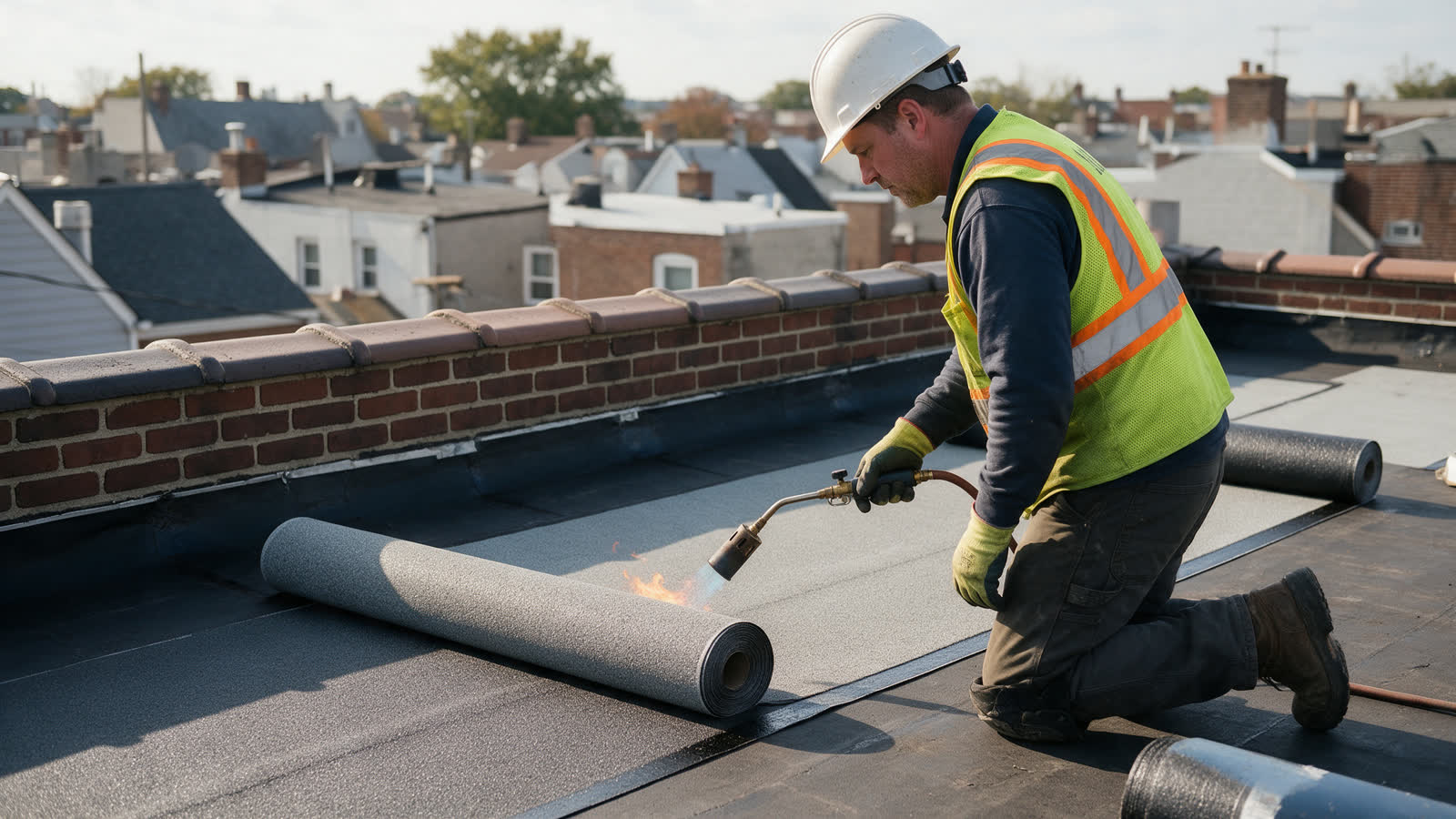
Modified bitumen is asphalt reinforced with a polymer — APP or SBS — installed in two or more plies. Built-up roofing (BUR) is the older layered felt-and-asphalt assembly that covered most of this region's mid-century commercial stock.
Both are redundant by design. Two plies means a defect in one is not automatically a leak, which is why they remain popular on roofs that get walked on constantly.
Torch application is fast and produces an excellent bond, but open flame on an occupied building carries obvious risk and many owners and insurers will not permit it.
Cold-adhered systems use adhesive instead of flame — slower, no ignition source. Self-adhered sheets are the cleanest option for occupied buildings and are what we default to where a torch is off the table.
If a contractor proposes torch-applied work on your occupied building, ask about their hot-work procedure, fire watch duration after the crew leaves, and what your insurer requires. If they have not thought about it, that is your answer.
Very few new BUR roofs go down today, but plenty of DMV buildings still have one. A sound BUR with dry insulation is an excellent candidate for a coating restoration rather than a replacement — the substrate is exactly what coatings are designed to renew.
A BUR with saturated insulation is not a candidate for anything but tear-off, whatever anyone tells you about a miracle coating.
| System | Installed cost / sq ft | Typical service life | Notes |
|---|---|---|---|
| Modified bitumen, 2-ply | $10 – $18 | 15–25 yrs | Tough underfoot. Good on small, complex, high-traffic roofs. |
| Built-up (BUR), 3–4 ply | $11 – $20 | 20–30 yrs | Rare as new work now; mostly repaired or overlaid. |
How to read these. Ranges are DMV market pricing for planning and budgeting, not a quote. Real numbers move with deck condition, insulation required to hit code, access and staging, how much rooftop mechanical equipment has to be lifted and reset, and whether the work is phased around tenants.
The requirements below apply throughout the DMV. Jurisdiction specifics are on each service area page.
Torch application on an occupied commercial building usually requires a hot work permit and a fire watch that continues after the crew leaves. Requirements are jurisdiction-specific and your insurance carrier may be stricter than the code.
Cap sheet, granule surfacing or a coating is part of the fire-rated assembly. The listing covers the whole build-up, not one ply.
Two existing layers means tear-off under IBC §1511, and older BUR roofs are frequently already at two.
The rule that decides most jobs: IBC §1511 prohibits a roof recover where the existing roof already has two or more applications of any roof covering. It also prohibits recovering when the existing roof is water-soaked or has deteriorated to the point that it is no longer an adequate base. In either case the code requires removal down to the deck. This is the single most common place a cheap bid quietly goes non-compliant.
No — it is niche now rather than default. On small complex roofs and roofs with heavy service traffic, a two-ply mod-bit is often more durable than a single-ply, and the redundancy is worth real money over critical space.
If the insulation under it is dry and the substrate is sound, yes — BUR is one of the best coating substrates there is. A moisture survey answers this definitively, and it is worth doing before you accept anyone's recommendation either way.
It can be done safely with proper hot work procedure and fire watch, but many owners and insurers simply prohibit it. Self-adhered and cold-adhered systems get you the same assembly without an ignition source, and that is what we recommend on occupied buildings.
A 30-minute consultation, then a written report with photos and numbers. No obligation.
Pick a time that suits you. We'll talk through the building, walk the roof, and send you a written condition report with photos and budget ranges for repair, restoration and replacement.
Opens our live calendar. Pick a time — there is no form to fill in.
Active leak? Don't book — call 202-798-7663. We triage leaks ahead of scheduled visits.