The District has more commercial flat roof per building than almost anywhere in the country — a consequence of the Height Act — and a permitting and historic review layer that punishes contractors who have not worked here.
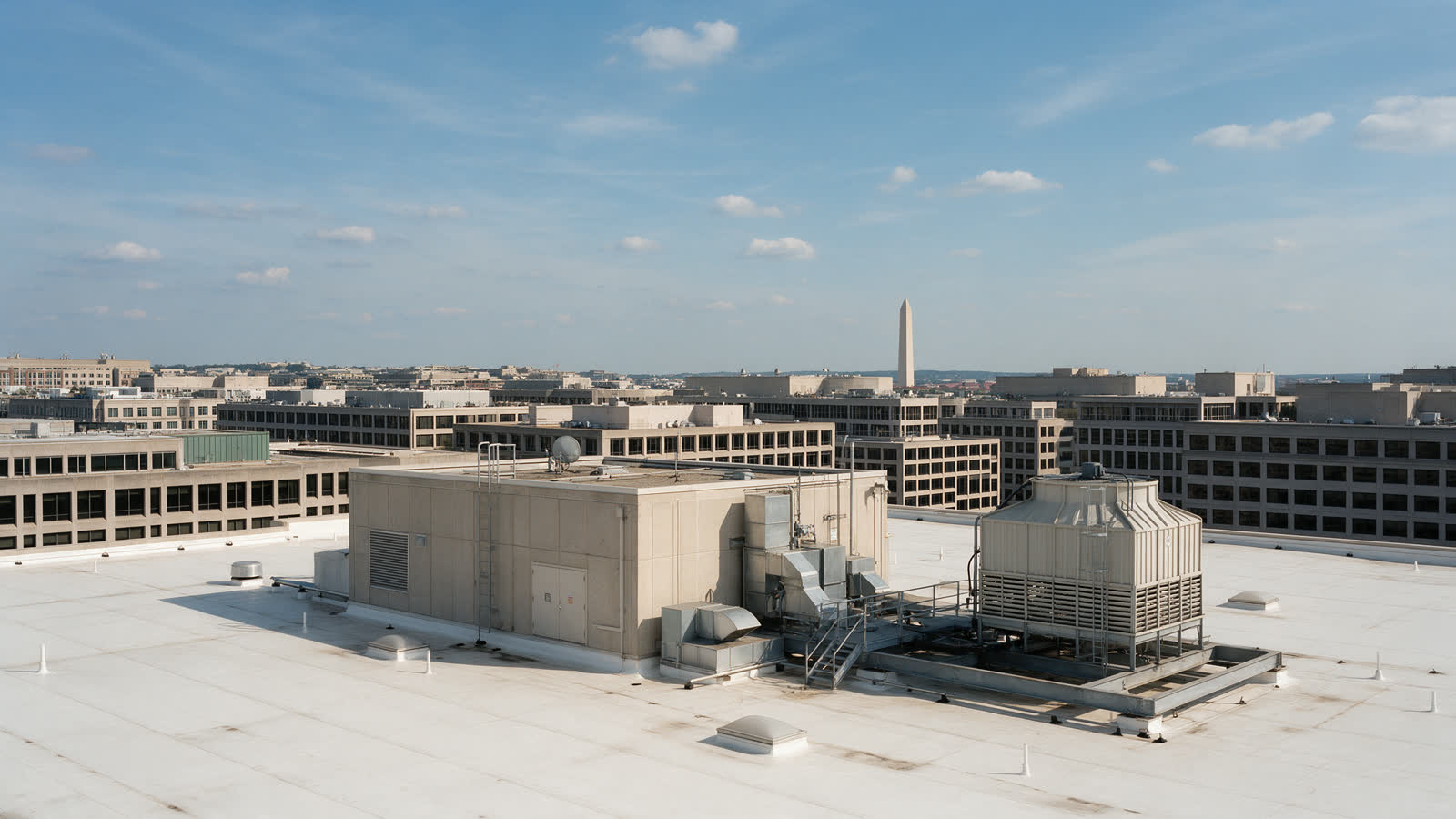
Because the Height Act caps building height, DC builds out rather than up. The practical result for you is that a downtown DC office building has an unusually large roof relative to its footprint and its floor count, crowded with mechanical penthouses, cooling towers, exhaust and screening. There is more roof to maintain, more penetrations per square foot, and less room to stage a job.
Outside the core, the District's commercial stock is dominated by pre-war and mid-century masonry multifamily, converted rowhouse commercial, institutional and nonprofit headquarters, and a large inventory of 1960s–80s low-rise office. Most of it is low-slope, much of it is on its second or third roof, and a meaningful share is at or past the two-layer limit that forces a tear-off.
Permits & who issues them
Permits and inspections moved to the Department of Buildings when DCRA was split in 2022 — plan review and inspections are DOB; business licensing is DLCP. Filings run through the DOB permitting portal.
Commercial reroofing normally requires a building permit. Like-for-like repair below the permit threshold may not, but a full replacement, a recover, a change of system, or anything structural does. Buildings in a historic district add a review step before the permit issues.
Pull it in the roofer's name. If a contractor asks you to take the permit out as the owner, they are moving liability for the work onto you. That is a reason to pick someone else.
The building code in force
The District enforces the 2017 DC Construction Codes, effective May 29, 2020. Those are the 2015 ICC model codes as amended by DCMR Title 12. Roofing sits in Chapter 15 of the building code, with the District's own amendments layered on top — so a spec that is fine in Maryland is not automatically fine here.
You get two roofs, then you tear off
IBC §1511 prohibits a roof recover where the existing roof already has two or more applications of any roof covering. It also prohibits recovering when the existing roof is water-soaked or has deteriorated to the point that it is no longer an adequate base. In either case the code requires removal down to the deck. This is the single most common place a cheap bid quietly goes non-compliant.
Energy code drives the insulation, and the insulation drives the price
The DMV sits in climate zone 4. For low-slope roofs with insulation entirely above the deck, the IECC commercial table calls for roughly R-30 continuous. On an older building that was built with two inches of insulation, meeting that number is frequently the largest single line item in a replacement — and the reason a tear-off costs meaningfully more than the recover somebody quoted you.
Edges and corners are not the field
Wind uplift concentrates at perimeters and corners, and ASCE 7 requires tighter attachment in those zones. A bid that specifies one fastening pattern for the whole roof is either an oversight or a shortcut. Ask to see the zones called out.
Drainage is a code item, not a preference
Roofs need primary drainage plus a secondary (overflow) path sized so a blocked primary drain does not load the structure with standing water. On replacements we look at whether existing overflow scuppers are present and correctly set — on older DMV buildings they often are not.
Local rules that actually change the job
Historic review is a real schedule item
The District has a large number of historic districts and individually landmarked buildings. Where roof work is visible from public space — and anything that changes a parapet, coping, penthouse or roofline usually is — Historic Preservation Office review comes before the permit issues. That is weeks, not days, and it is the single most common reason a DC roofing schedule slips. We flag it during the condition report rather than after you have signed a contract.
BEPS is now a roofing conversation
Under the District's Building Energy Performance Standards, privately owned buildings over 50,000 sq ft are in the first compliance cycle, which closes December 31, 2026, and benchmarking now reaches buildings down to 10,000 sq ft. A roof replacement is one of the few capital moves that improves envelope performance meaningfully — insulation to current code plus a reflective membrane — and it is far easier to justify to a board when it is doing double duty against a BEPS obligation. If your building is in a compliance cycle, tell us; it changes what we recommend.
Stormwater and green roofs
The District has some of the most aggressive stormwater retention requirements in the country, and green roofs count toward them. DOEE has run rebate programs for voluntary green roof installation, weighted toward the MS4 area and Wards 7 and 8, and the Stormwater Retention Credit market lets qualifying installations generate tradeable credits. Funding and program status change from year to year, so confirm current terms with DOEE before you build a budget around them — but if you are replacing a roof anyway, it is worth asking the question before the design is fixed.
Access, staging and permits beyond the building permit
Downtown DC jobs frequently need more than a building permit: public space occupancy for a dumpster or crane, DDOT sidewalk closure, after-hours work agreements in mixed-use buildings. On a tight L Street site those approvals drive the schedule more than the roofing does.
Inspections
Expect at minimum an in-progress inspection while the assembly is open and a final. Keep the deck and any replaced insulation visible until it has been seen — covering work before an inspection is the fastest way to be told to open it back up.
Deck inspection after tear-off, before anything covers it.
In-progress inspection of the assembly and attachment pattern.
Final inspection of the completed roof, flashings and drainage.
Manufacturer field inspection where an NDL or extended warranty is being issued — separate from the jurisdiction, and required for the warranty to activate.
What commercial roofing costs here
System
Installed cost / sq ft
Typical service life
Notes
TPO, mechanically attached
$9 – $16
20–30 yrs
Most common DMV replacement. Reflective, heat-welded seams.
TPO, fully adhered
$11 – $19
20–30 yrs
Quieter, better wind performance, no fastener pattern telegraphing.
EPDM, mechanically attached
$8.50 – $15
20–30 yrs
Proven on older stock. Black absorbs heat; ballast or white options exist.
EPDM, fully adhered
$10.50 – $18
25–30 yrs
Cleaner detailing around heavy penetration counts.
PVC single-ply
$11 – $19
20–30 yrs
Grease and chemical resistant — restaurants, kitchens, industrial exhaust.
Modified bitumen, 2-ply
$10 – $18
15–25 yrs
Tough underfoot. Good on small, complex, high-traffic roofs.
Built-up (BUR), 3–4 ply
$11 – $20
20–30 yrs
Rare as new work now; mostly repaired or overlaid.
Silicone restoration coating
$3.50 – $7
10–20 yrs
Only over a sound, dry substrate. Renewable warranty at end of term.
Metal retrofit / recover
$12 – $25
30–40 yrs
Wide range — standing seam over purlins vs. coating an existing panel roof.
How to read these. Ranges are DMV market pricing for planning and budgeting, not a quote. Real numbers move with deck condition, insulation required to hit code, access and staging, how much rooftop mechanical equipment has to be lifted and reset, and whether the work is phased around tenants.
Investigation, maintenance and the things that get discovered
Item
Typical range
Notes
Leak investigation and repair
$500 – $5,000
Most single-source leaks land in the low four figures. Chronic leaks need a survey, not a patch.
Infrared or moisture survey
$0.05 – $0.15 / sq ft
Maps wet insulation so you replace only the saturated area instead of the whole field.
Preventive maintenance program
$0.08 – $0.20 / sq ft / yr
Two inspections a year plus minor repairs. Usually required to keep an NDL warranty alive.
Tapered insulation for drainage
$2 – $5 / sq ft (added)
Where ponding has to be corrected rather than lived with.
Deck replacement
$6 – $14 / sq ft (added)
Only discovered once the old roof is off. Should be a unit price in your contract, not a change order fight.
How to read these. Ranges are DMV market pricing for planning and budgeting, not a quote. Real numbers move with deck condition, insulation required to hit code, access and staging, how much rooftop mechanical equipment has to be lifted and reset, and whether the work is phased around tenants.
Important things to know in Washington, DC
The permitting authority is the Department of Buildings, not DCRA. DCRA was split in 2022 — plan review and inspections are DOB, business licensing is DLCP. A contractor still saying "DCRA" has not pulled a DC permit recently.
DC enforces the 2017 Construction Codes, based on the 2015 ICC model codes. That is an older base code than Maryland or Virginia — a spec written to the 2021 IBC needs checking against the District's amendments.
Parapet height matters. Adding several inches of insulation to meet energy code can leave a parapet too short for a code-compliant base flashing height. That is solvable, but it is a design decision, not a field improvisation.
Rowhouse-scale commercial buildings share party walls. Roof work at a shared parapet needs the neighbour informed and, often, access negotiated in advance.
And everywhere in the DMV
Get the permit in the contractor's name. If a roofer asks you to pull it as the owner, they are moving liability onto you.
Ask for the unit price on wet insulation and deck replacement before the contract is signed. Those are the two things nobody can see until the roof is open, and they are where an honest job and a bad one diverge.
A manufacturer NDL warranty is issued to the building, not to the contractor — but it usually requires a certified installer and documented maintenance. Confirm both before you rely on it.
Photograph the roof before work starts, including the mechanical equipment. It settles most disputes about who damaged what.
Questions we get
Do I need a permit to replace a commercial roof in DC?
In nearly all cases, yes — a building permit through the DC Department of Buildings. Like-for-like repair below the code threshold may be exempt, but a replacement or recover is not. If the building is in a historic district or is a landmark, Historic Preservation Office review comes first.
How long does DC historic review add to a roofing project?
It varies with the scope and whether the work is visible from public space, but plan in weeks rather than days. The way to avoid it hurting is to identify it at assessment and start the review while the rest of the project is still being scoped.
Will a new roof help with BEPS compliance?
It can contribute meaningfully. Insulation brought to current energy code plus a reflective membrane reduces cooling load and site EUI. It is rarely a whole compliance strategy on its own, but it is a capital project you were going to do anyway that also moves the number.
What does a commercial roof replacement cost in DC?
DC generally sits at the upper end of the regional range — $10 to $19 per square foot for most low-slope replacements — because of access constraints, staging costs, dense rooftop mechanical equipment and public space permitting. The condition report gives you a real figure for your building.
Pick a time that suits you. We'll talk through the building, walk the roof, and send you a written condition report with photos and budget ranges for repair, restoration and replacement.
 VA
VA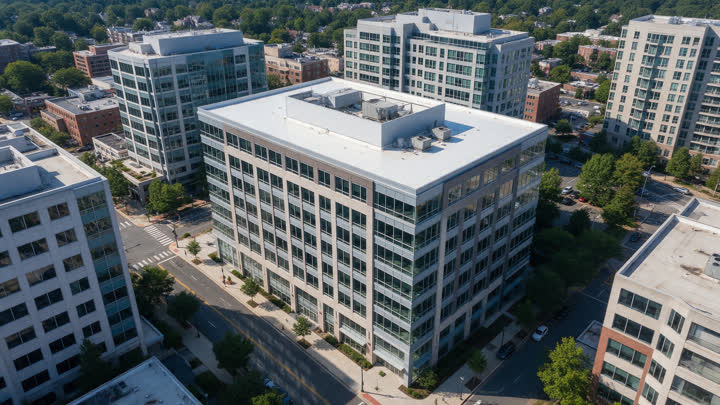 MD
MD MD
MD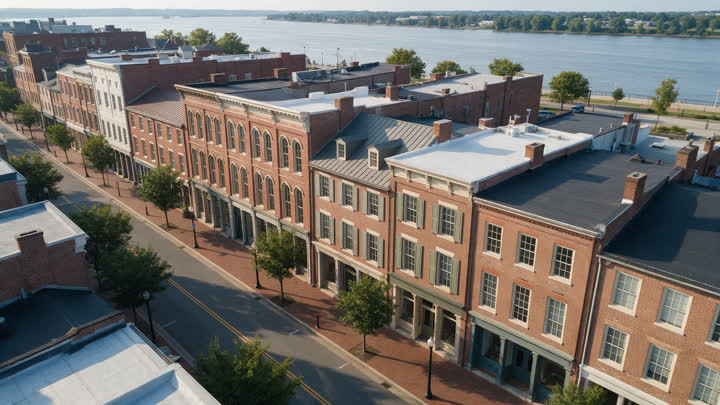 VA
VA