Bird damage on commercial roofs builds up slowly. Pigeons roost on the parapet coping. A nest goes into the gap behind a rooftop unit's panel. Droppings, feathers and twigs drift into the drain basket. Nobody notices until a drain backs up in a storm or a technician refuses to open a unit.
Late October is the right time to deal with it. Most native birds have finished nesting for the year, the leaves are coming down, and the HVAC changeover brings a contractor to the roof anyway. This post covers what a facility team can check without going near an edge, what federal law says about removing nests, why droppings are not a job for the porter, and where the work passes to a roofer, an HVAC contractor or a wildlife professional.
Why animals are the owner's problem, not the warranty's
Read the exclusions in your roof warranty before anything else. Duro-Last's published warranty forms, for example, exclude "damage caused by... animals, insects" in the same list as hail, fire and vandalism (Duro-Last care and maintenance guide). Other manufacturers word it differently, so check your own document. In most cases, though, the manufacturer does not pay for what birds, rodents or insects do to the roof. Preventing that damage, and having the records to show you tried, falls to the owner.
The manufacturers' owner guides also make a related point about food waste. Mule-Hide says not to exhaust kitchen waste or animal fats directly onto the roof, and that TPO and PVC roofs on restaurants need a maintenance programme that regularly removes grease (Mule-Hide care and maintenance). IKO calls for a sacrificial protective layer and monthly roof cleaning on restaurant roofs (IKO building owner's guide). If your building has a kitchen exhaust fan on the roof, those instructions apply to you. Our post on what your roof warranty requires of you each year covers the rest of the owner's side of the deal.
What federal law says about nests
Most facility teams assume they can clear any nest they find. For most native birds that is wrong while there are eggs or young in it. The Migratory Bird Treaty Act protects more than 1,100 species, including their nests and eggs. The U.S. Fish and Wildlife Service set out its current position on nests in a January 2025 memorandum (FWS MBPM-2-02).
Some common roof birds are not covered. FWS publishes a list of nonnative species the MBTA does not apply to, and the rock pigeon is on it. The European starling and the house sparrow fall outside the Act because their families are not covered by the treaties (FWS nonnative species list). FWS notes that the list itself has no legal effect, and that states and localities may protect these species anyway. If you can't identify the bird with confidence, treat the nest as protected and ask a licensed wildlife control operator.
Why droppings are a specialist cleanup
Droppings are the part most teams underestimate. NIOSH explains that histoplasmosis is caused by a fungus that grows in soil and material with large amounts of bird or bat droppings, and that people catch it by breathing in airborne spores. Disturbing large accumulations of droppings is on its list of high-risk tasks (NIOSH histoplasmosis key points). NIOSH advises employers to suppress dust, for example by spraying water, to provide personal protective equipment with training, and says large accumulations should be cleaned up by a professional company that specialises in hazardous waste (NIOSH feature).
So the rule for your team is simple. Don't dry-sweep, scrape, shovel or blow out droppings on the roof, in a mechanical penthouse or around an air intake. Record where they are and how much there is, and bring in a specialist. Never pressure-wash them off the membrane either. Cleaning the roof surface is a job for the roofer or the specialist, not for your staff.
What your team can check without going on the roof
Everything below is done from inside the building, from the roof hatch landing with the hatch open and nobody stepping out, or from a window that overlooks the roof. Anyone who does go onto a low-slope roof is covered by OSHA's rules in 29 CFR 1910.28(b)(13): fall protection within 6 feet of an edge, and protection, a designated area or an enforced work rule farther back. Skylights count as holes. The full table is in our fall roof maintenance checklist. Don't open the hatch in wet, frosty, snowy or windy weather.
1. Find the roosts
From the landing or a window, with a phone camera zoomed in, look for white streaking on parapet copings, ledges, unit housings and sign frames. Streaking concentrated in one place is a roost.
2. Look at the drains and scuppers
Feathers, nesting twigs and droppings end up in the same place as leaves. A drain basket packed with that material is a ponding and overflow risk in the next storm. Our post on roof drains, scuppers and overflows explains what a blocked drain does, and who should clear it.
3. Check the equipment from a distance
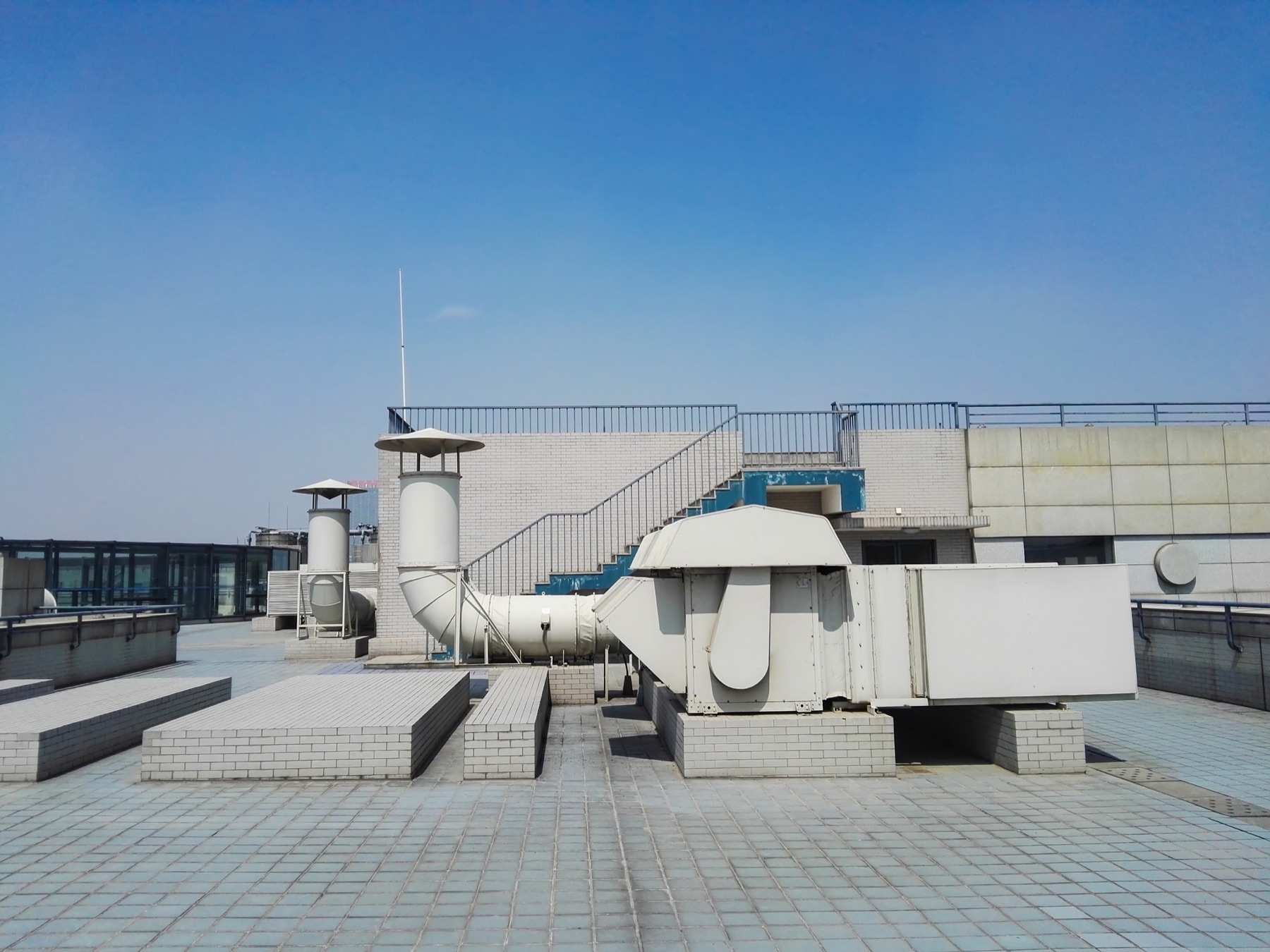
Birds nest in the gaps of rooftop units, exhaust fans and louvres. Look for twigs or grass sticking out of panel joints, missing access panels and birds flying in and out. Tell your HVAC contractor before the next service visit, so the technician comes prepared and knows the nest rules.
4. Read the inside of the building
Rodents and insects show up indoors first. Look for droppings or gnaw marks in the top-floor ceiling space, insulation pulled out around roof penetrations, and insects at the roof hatch curb. A pest control contractor should identify the animal; your job is to record where and when you saw the signs.
5. Put it in the record
Date every observation and keep the photos with your roof file, using the method in our roof photo log post.
When it becomes a roofer's job
Your team observes and records. Everything else belongs to someone licensed for it:
- Any puncture, peck hole, gnawed flashing or torn seam goes to a roofer. Don't patch, seal or tape it.
- Removing an inactive nest, installing spikes, netting or other deterrents goes to a wildlife control operator or the roofer, and anything fixed to the roof must be agreed with the roofer so it doesn't penetrate the membrane or affect your warranty.
- Nests inside rooftop equipment, damaged louvres and screens go to the HVAC contractor. Electrical and mechanical work is for licensed trades.
- Large droppings accumulations go to a hazardous-waste cleanup specialist, per NIOSH.
- Rodents and insects go to a licensed pest control contractor, with the roofer checking any penetration they find.
Our roof maintenance programmes page explains how scheduled spring and fall visits catch blocked drains and small damage early, and our roof repair team handles the damage once the animal problem is under control.
Frequently asked questions
Can we remove a bird nest from our rooftop unit?
If it holds eggs or young and the bird is a protected native species, not without federal authorization. If it is inactive, FWS says it can be destroyed without a permit as long as nobody keeps it, but the person removing it must be sure it is inactive. Rock pigeons, starlings and house sparrows are outside the MBTA, though state or local rules may still apply.
Are pigeon droppings on the roof a health hazard for our staff?
NIOSH lists disturbing large accumulations of bird or bat droppings as a high-risk task for histoplasmosis. Keep staff from sweeping or scraping them, and have large amounts removed by a specialist company.
Does our roof warranty cover damage from birds or animals?
Often not. Duro-Last's published warranty forms exclude damage caused by animals and insects, and other manufacturers use similar wording. Read the exclusions in your own warranty.
When is the best time to install bird deterrents on a commercial roof?
FWS recommends working outside nesting season to reduce the risk of taking a protected bird. In the DMV that generally points to late autumn and winter, but have a wildlife professional check for in-use nests first.
Do bird spikes or netting damage the roof membrane?
They can if they are fastened through it. Have the roofer agree the attachment method before anything is installed, and check whether your manufacturer needs to be told.
Get the roof checked once the birds are gone
If roosting, nesting or droppings have been building up on your roof, a written condition report will show whether the membrane, flashings and drains need attention. Book a free 30-minute consultation at https://dmvcommercialroofing.com/#book or call 202-798-7663.
Header photo: xb100 / Magnific.