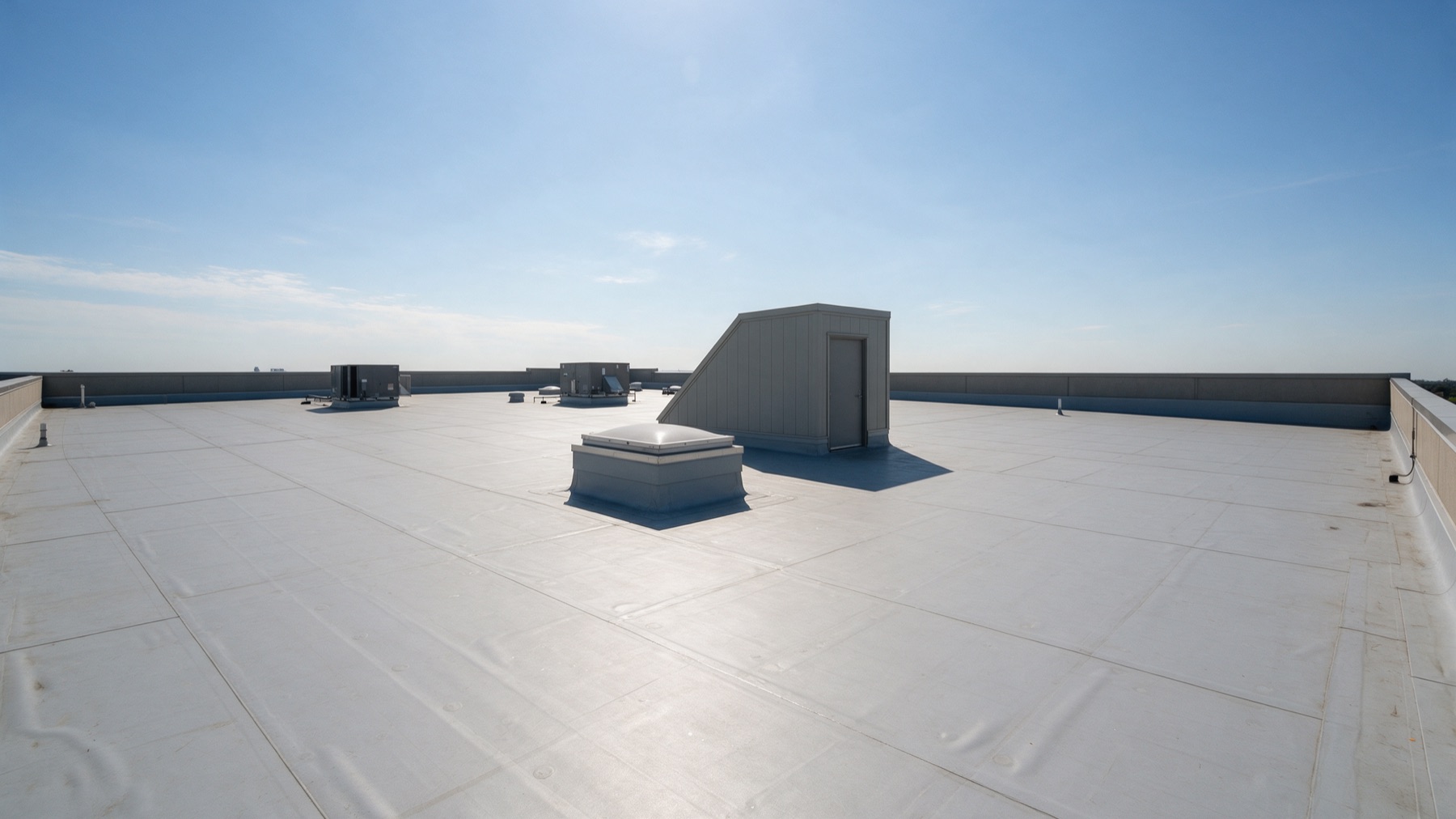
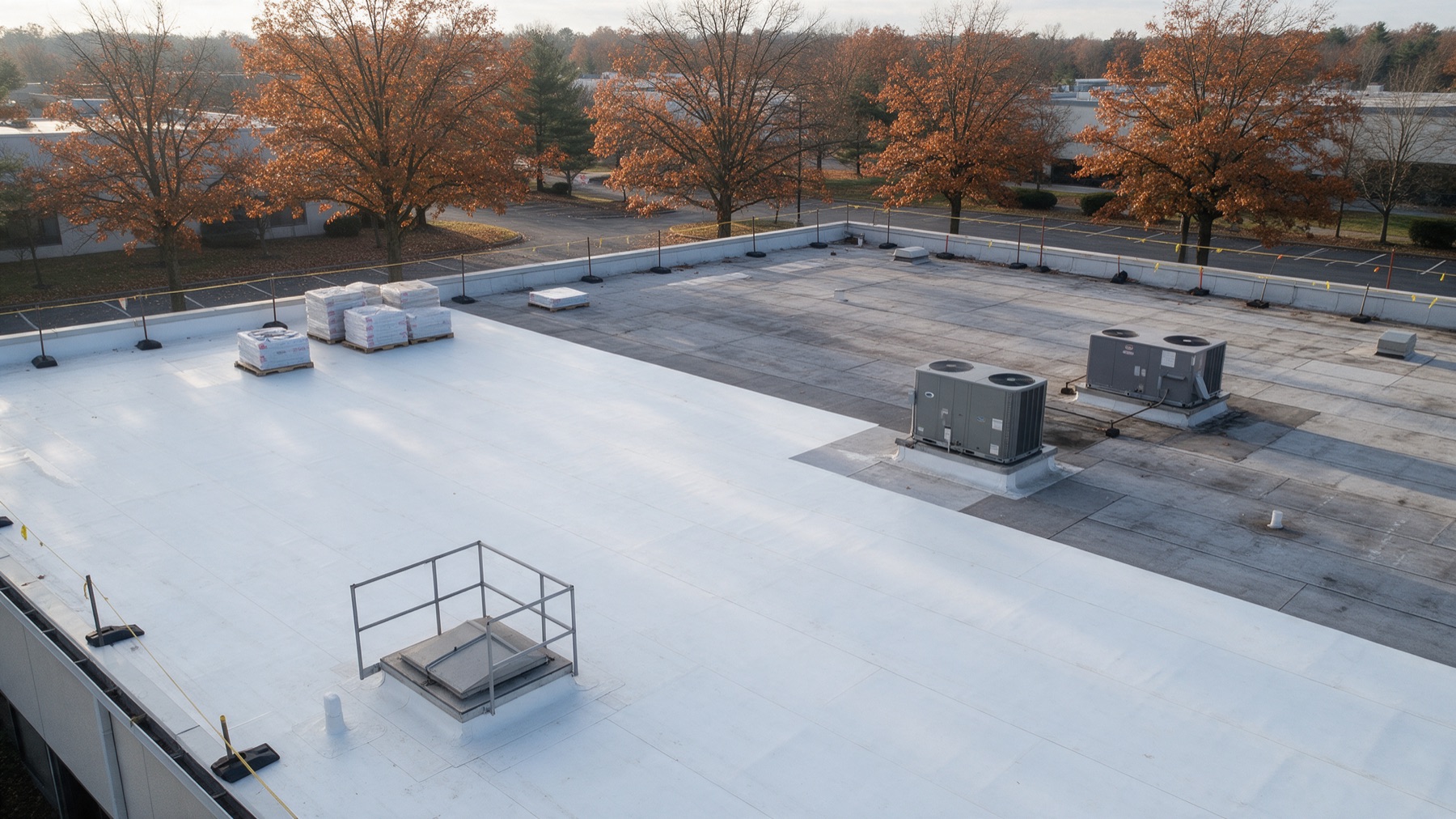
Every roof visit starts with a ladder and a hatch, and that is where a facility team has the most control over safety. Roof hatch and ladder safety is not about the membrane at all. It is about whether the person climbing up can get through the opening and onto the roof without falling, and whether the hatch is left in a condition that will not hurt the next person.
This post is a landing-level audit your own team can run from the floor, with the rules that apply and the point where the work belongs to a licensed trade or a roofer.
Start with what OSHA actually says
The general-industry walking-working surfaces rules treat a roof hatch as a hole. Under 29 CFR 1910.28(b)(3), employees must be protected from falling through any hole, including skylights, using covers, guardrail systems, travel restraint or personal fall arrest. For a hatchway, the standard points to a hinged floor-hole cover meeting 1910.29, and says the cover must be closed when the hole is not in use (OSHA 1910.28).
Covers themselves are addressed in 1910.29(e): they must support at least twice the maximum intended load and be secured against accidental displacement (OSHA 1910.29).
Fixed ladders are covered by 1910.23. Among the points that matter for an audit: rungs spaced 10 to 14 inches apart (b)(2), side rails extending at least 42 inches above the landing (d)(4), ladders inspected for visible defects before use each shift (b)(9), and defective ladders tagged and removed from service (b)(10) (OSHA 1910.23).
Your building may also fall under other rules, such as a lease, an insurer's requirements or a local code, so treat this as the federal baseline and confirm with your safety consultant.
What this audit is, and is not
It is a look at the access route from the interior, up to the hatch opening. It does not send anyone onto the roof. Once a person steps out, the low-slope edge rules apply, and the full table is in our fall maintenance checklist. In short, fall protection is required within 6 feet of an edge under 1910.28(b)(13), and a work rule keeping staff 15 feet back applies otherwise. Skylights are holes. Nobody goes up on a wet, frosty, snowy or windy day.
The landing-level audit
Five checks a facility team can do from the floor
- Look up the ladder before anyone climbs it. A quick visual pass on rungs, rails and fasteners. If anything looks bent, loose or heavily rusted, tag the ladder "Dangerous: Do Not Use" and stop. OSHA 1910.23(b)(10) requires defective ladders to be removed from service.
- Check what is on the ladder and around it. Items stored at the base, wet floors from a nearby leak and poor lighting turn a safe climb into a fall.
- Test the hatch from a safe position. Confirm it opens and closes cleanly, the latch catches and the opening is not left propped. Do not lean through the opening.
- Confirm the cover is closed when nobody is on the roof. An open hatch is an unguarded hole and a path for water and pests. Make closing it part of the sign-out routine in your rooftop HVAC access policy.
- Photograph and date what you see. Add the images to the log described in our photo log post, so a change from last quarter is obvious.
Roof hatches and weather
A hatch curb is a roof penetration. If you see water staining on the ceiling below it, fogged-up glazing, or daylight around the edges, record it and ask a roofer to look at the flashing. Do not seal around it yourself. For stains in general, our guide to a ceiling stain leak shows how to document them.
Planning ranges, not quotes
Adding guarding, replacing a hatch or modifying a ladder varies widely with the building, the access route and the contractor. As a rough DMV planning exercise, treat each as a separate line item and get it priced in writing. A roofer's or safety contractor's written scope gives the real figure; no number in a blog post should be relied on.
When it becomes a roofer's job
Your team handles looking, logging and enforcing the policy. Hand it off when:
- The hatch curb, flashing or cover shows water entry, rust-through or a failed gasket.
- The hatch does not close fully, or the hardware is damaged.
- Guarding, gates or fall-arrest anchors need to be added or changed. That is work for a qualified safety contractor and, where it touches the roof, a roofer.
- A ladder needs rails extended, a replacement or a safety system. That goes to a fabricator or safety contractor.
- Electrical, gas or HVAC equipment near the access route needs attention. That is for the licensed trades, not building staff.
Do not patch, seal, caulk or probe around the curb, and do not send anyone out to inspect the membrane from the hatch. Our roof maintenance programs and commercial roof repair pages describe how roofer-led inspections and repairs are handled.
FAQ
Does OSHA require a roof hatch to be guarded?
OSHA 1910.28(b)(3) requires protection from falling through holes, including skylights, and points to a hinged floor-hole cover for hatchways that must be closed when not in use. Whether you also need a guardrail or gate depends on how the hatch is used, so confirm with a safety professional.
How often should a roof access ladder be inspected?
OSHA 1910.23(b)(9) requires inspection for visible defects before initial use each work shift and more often as needed. For a rarely used ladder, that means before each trip.
Can my maintenance team replace a damaged roof hatch?
Replacing the hatch means cutting into the roof and re-flashing the curb. That is roofing work, and it can affect the warranty. Have a roofer do it.
Is a ladder with a cage required for a roof hatch?
The 1910.23 text sets rules for ladders without cages or wells, including clearances, and covers ladder safety systems. It does not simply require a cage in every case. Ask a qualified safety professional about your specific ladder.
What should I do if the hatch is found open?
Treat it as an unguarded hole. Keep people away, close and latch it from a safe position, and record who last had access. Add a sign-out step to your policy so it does not recur.
Next step
If your hatch, curb or access route shows damage you cannot judge from the floor, a short written condition report will say what needs fixing and by whom. Book a free 30-minute consultation at https://dmvcommercialroofing.com/#book or call 202-798-7663.
Header image: AI-generated illustration (Magnific).