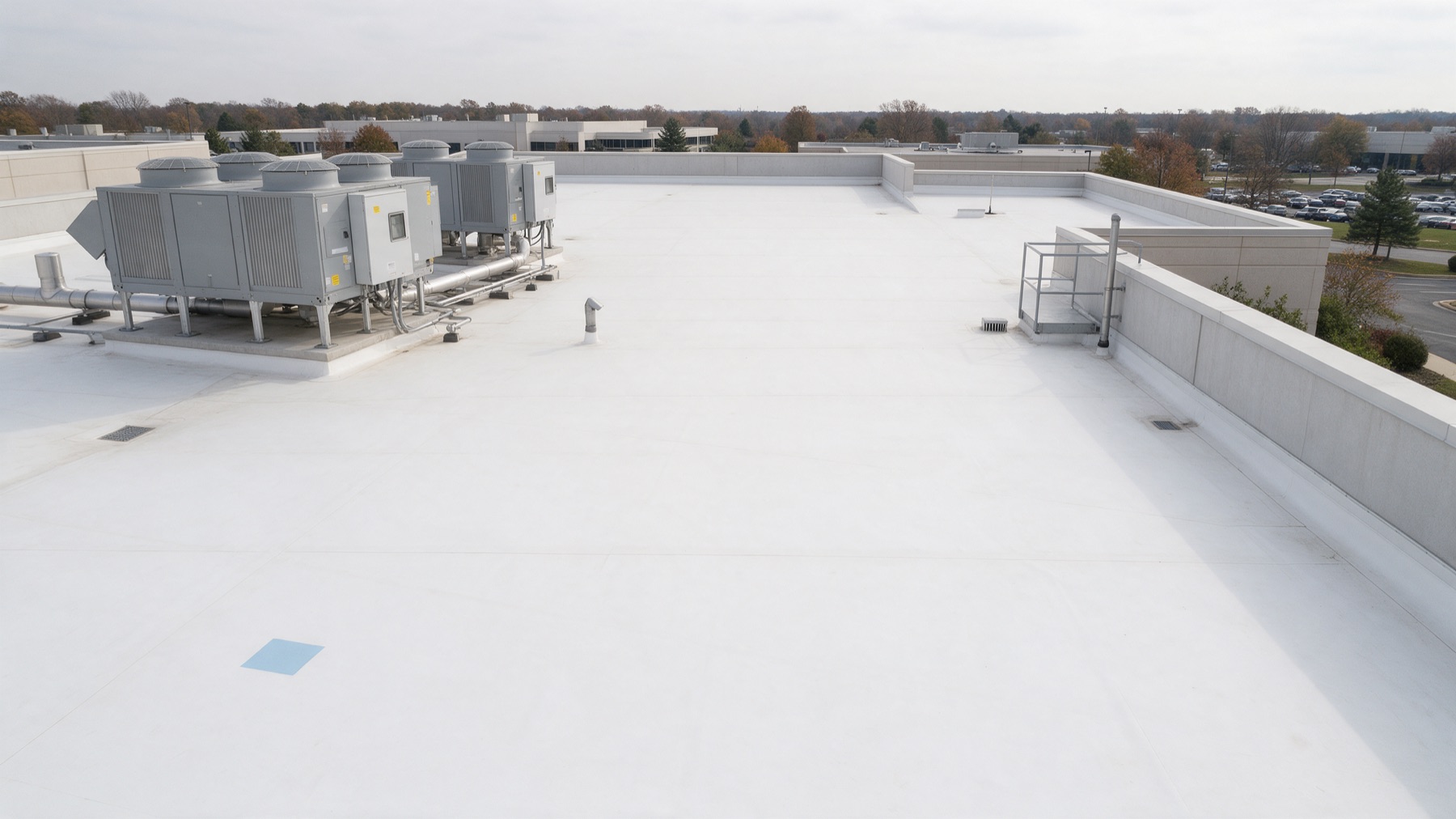
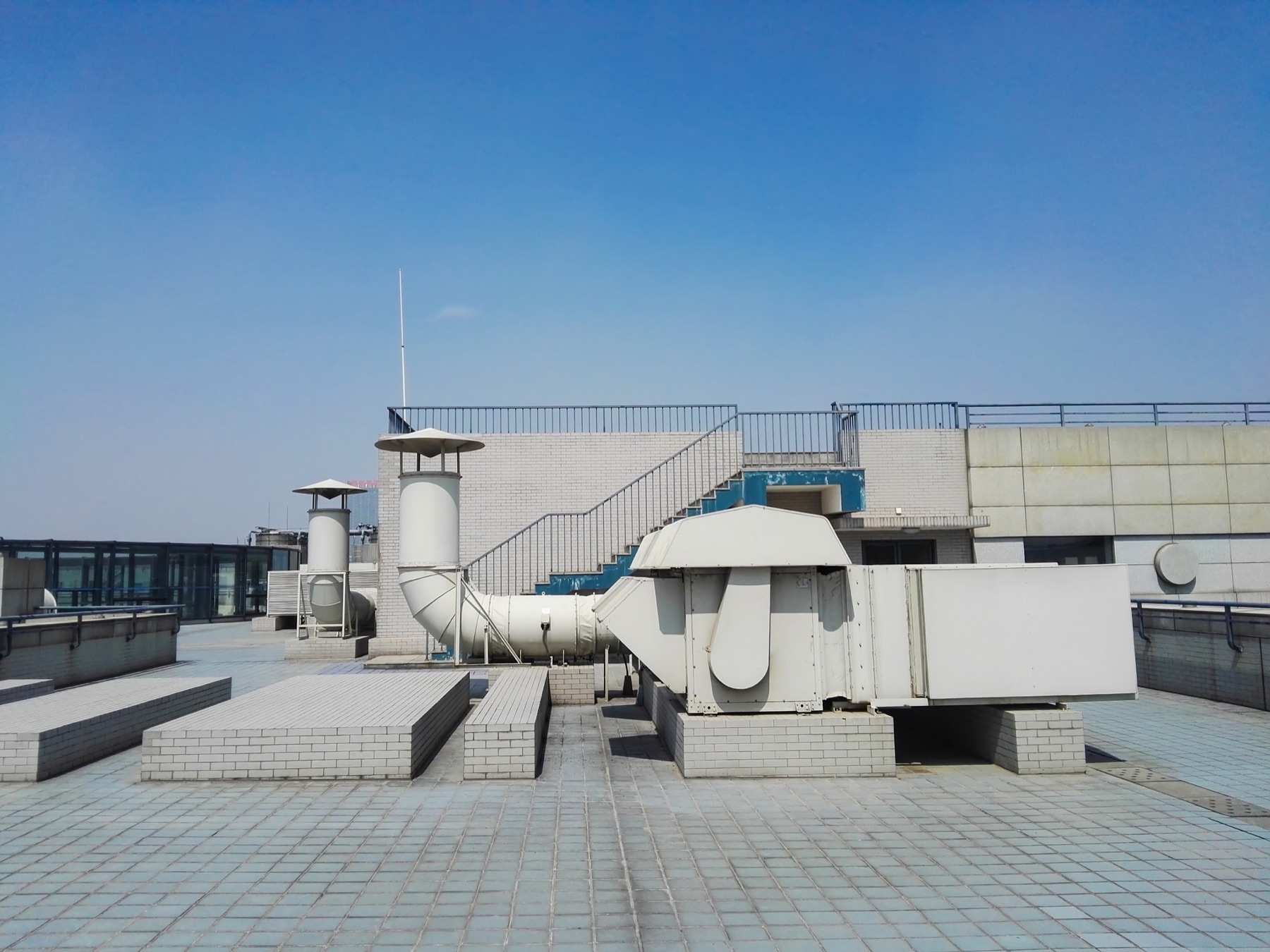
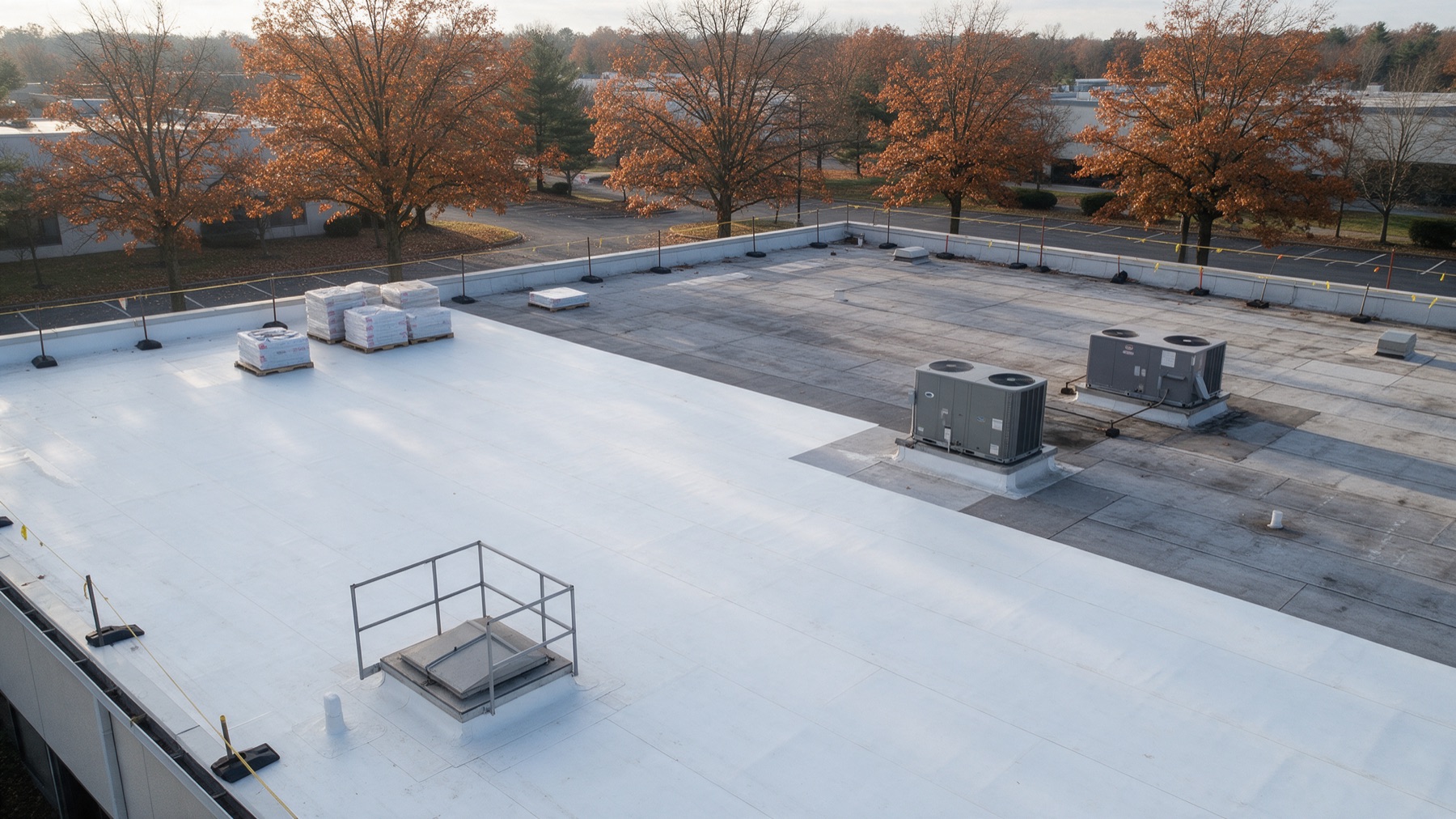
When a commercial roof leaks and the manufacturer, the installer and the insurer each ask what the roof looked like last year, the building with a file answers in an afternoon. The building without one spends weeks reconstructing it from memory and invoices. A commercial roof photo log is that file. It is one of the few roof tasks that costs almost nothing, needs no one on the membrane, and gets more valuable every year it runs.
This post sets out what belongs in the record, how your facility team can build it without going near a roof edge, and where it hands off to a roofer.
Why a roof record matters more than any single inspection
Roof problems rarely arrive as a surprise. They arrive as a slow change that nobody was positioned to notice: a ponding patch that grows a little each summer, a seam that lifts after each freeze, a curb flashing that was fine in March.
NRCA's guidance for owners is to inspect at least twice a year, ideally spring and fall, plus after major storms, and to document conditions in writing with photographs and keep them on file. That file "can provide a basis for comparing changing conditions during subsequent inspections" (Professional Roofing). The photo is not the point. The comparison is.
There is a second reason. Manufacturer warranties and contractor warranties usually carry owner obligations, and you may be asked to show you met them. FacilitiesNet's advice to owners is to keep a roof log and to record maintenance and repairs, because those entries may be needed for warranty claims (FacilitiesNet). What a particular warranty requires is written in that warranty. Read your own document; do not assume.
What goes in the roof maintenance record
Think of the record as two parts: a fixed profile of the roof, and a running log of what happens to it.
The fixed profile
Set this up once and correct it when something changes. FacilitiesNet lists the details worth capturing for each roof system: system type, manufacturer, warranty period and coverage, approximate area, linear footage of perimeter flashing or coping, installation date and installer. It also suggests tying the entries to a roof plan, paired with a plan of the level below, so each roof area's characteristics are visible at a glance.
If you do not know some of these, say so in the file and note where you will look. Unknown is a legitimate entry. A guess is not.
The running log
The roof access row connects to a separate habit. If other trades service rooftop equipment, a written sign-in and walk-path policy protects the membrane, and our post on a rooftop HVAC contractor roof access policy covers how to set one up.
How to take roof photos without going near the edge
This is where most photo programs go wrong, so the rule comes first. No one on your team should walk the roof to take photos, and no one should ever approach an edge, a parapet or a skylight for a better angle. OSHA's low-slope rules under 29 CFR 1910.28(b)(13) set fall protection requirements within 6 feet of an unprotected edge, and treat every skylight as an open hole (OSHA 1910.28). Our fall maintenance checklist lays out the full table.
Instead, shoot from places that are already safe:
- Ground level and parking areas: perimeter metal, coping, wall flashing, downspouts, staining below scuppers, and any visible sagging or debris on the edge.
- Upper-floor windows and stairwell landings: a view of the adjacent lower roof, which is often the area that collects the most debris.
- Interior spaces: ceilings, top-floor walls, mechanical rooms, around roof drain bodies and pipe penetrations, and below any roof opening.
- The hatch landing only if the hatch is guarded and your policy allows it: photograph what you can see without stepping out. If the hatch has no guard, do not use it.
Whoever takes the picture, a few conventions make them useful a year later:
- Same spots, same angles. Pick fixed viewpoints and number them on the roof plan. Photograph the same view each time.
- Wide, then close. One wide shot shows where; one close shot shows what.
- Date and location in the file name. For example,
2026-10-18_NE-corner_drain-3.jpg. Do not rely on camera metadata surviving a transfer.
- Include a scale cue where you can, such as a standard-size object that is already there, and never place anything on the roof to do it.
- Photograph the "good" areas too. An empty ceiling tile grid in October is evidence in March.
- Keep the originals. Do not edit, crop over or compress the master copy.
A simple annual rhythm
You do not need software. A shared folder and a spreadsheet work.
- Spring and fall: walk the safe viewpoints, take the fixed photos, log what changed.
- After any named storm or hail event: run the same viewpoints within a day or two and file the result. Our after-storm roof check covers what to look for.
- After any leak: photograph the interior stain, note the weather, and add it to the log before anyone repairs anything.
- Every time a contractor visits: file their sign-in, report and invoice, and ask for before and after photos.
- Once a year: review the log with your board, owner or manager, and flag anything that has moved.
For a multi-building portfolio, give every roof area an ID that matches the roof plan. A log that says "the roof" is nearly useless on a campus.
When it becomes a roofer's job
A photo log records what your team can see. It does not diagnose what is under the membrane. Call a roofer when:
- Photos from two successive inspections show the same area getting worse: ponding that now holds longer, a growing stain, a seam or flashing that has lifted further.
- You need anything done on the roof surface, including walking it to look closely. Patching, sealing, cutting into, probing or pressure-washing the membrane is not a facility-team task, and a DIY repair can complicate a warranty. NRCA suggests that when a roof is under warranty, the original installing contractor make repairs to avoid conflicts.
- A leak appears and you cannot trace it from the inside.
- The roof is nearing the end of its warranty or expected service life and you need a written condition report to plan the budget.
- Anything involves rooftop electrical, gas or HVAC equipment. Those go to the licensed trades.
A roofer working from a good photo log can find the problem faster and charge for less time. Our roof maintenance programs include documented inspections that feed straight into this kind of file, and commercial roof repair handles the work your team should not.
Frequently asked questions
How often should I photograph my commercial roof?
NRCA's guidance is at least twice a year, ideally spring and fall, plus after major storms. Photograph the same viewpoints each time so the images are comparable.
Do I need a drone to document my roof?
No. A drone can help on large or complex roofs, but it adds its own considerations, including operator qualifications and airspace rules for your location. Most buildings can start with ground, window and interior photos. If you want aerial images, ask a qualified roofing contractor to include them in a condition report.
What should be in a roof maintenance record for a warranty claim?
Your warranty document says what the manufacturer or installer requires. As a general practice, keep the warranty itself, the original construction documents if you have them, inspection records, repair invoices, contractor reports and photos. Ask the issuer which records they expect, in writing.
Can my maintenance staff take photos from the roof?
Your own safety policy and OSHA's fall protection rules decide that, and the safest answer for routine work is no. Photograph from the ground, windows and interior spaces, and leave roof access to trained, protected personnel.
How long should I keep the roof file?
Keep it for the life of the roof and the warranty period, and pass it to the next owner or management company when the building changes hands. A building sale or a manager change is when files usually go missing.
Start the file this week
If your roof has no record today, start with the profile, one set of fixed-view photos and a folder. That is an afternoon. If you would like a second set of eyes on what you find, book a free 30-minute consultation at https://dmvcommercialroofing.com/#book or call 202-798-7663. The consultation leads to a written condition report you can add straight to the file.
Header image: AI-generated illustration (Magnific).