Most commercial roofs in the DMV are not worn out by weather. They are worn out by the people who go up there to work on something else. A rooftop unit gets serviced several times a year, and every visit brings boots, ladders, tools, filters, panels and sometimes a refrigerant cylinder across a membrane that may be little more than a millimetre thick. A written contractor roof access policy is the cheapest way to stop that. It costs almost nothing to run, and your facility team can run it without ever touching the roof itself.
October is a good month to put one in place. The heating changeover brings mechanical contractors up to the roof just before the freeze-thaw season, when small punctures turn into wet insulation.
Why rooftop HVAC work damages roofs
Forensic engineers at Rimkus list the main ways rooftop HVAC units damage roofs: condensate drainage, vibration, foot traffic and flashing failures. They identify the flashing at equipment curbs as the most common failure point (Rimkus, 2026). A trade publication made the same point years ago: setting a toolbox on the membrane while climbing through the hatch is likely to cause a puncture, and many single-ply membranes are only 0.045 in. thick (Buildings.com).
The usual sources of damage, and what stops each one:
What it means for your warranty
Rimkus notes that roof membrane warranties commonly exclude damage caused by other trades, including improperly mounted equipment, unauthorised penetrations and missing walk pads. Read the exclusions page of your own warranty. Clauses about traffic, storage and alterations are common, and the exact wording decides who pays.
Manufacturers also expect to be told before the roof is changed. Carlisle's guidance on solar installed on a warranted roof requires the owner to complete a Letter of Compliance form before installation. Any penetrations or anchors must be installed or flashed by a Carlisle authorised applicator, and any damage must be repaired before the warranty continues (Carlisle TecTopics). Public owners write this into their specifications too. New York State's master specification for changes to a warranted roof requires an applicator approved by the existing roof's manufacturer, and a letter from the manufacturer confirming the work will not modify or void the warranty (NY OGS Section 070150).
The point for a facility team is simple. If an HVAC contractor adds a curb, a support or a pipe penetration without your roofer, you may be paying for every leak around it yourself.
The contractor roof access policy, clause by clause
Keep it to one page. Attach it to every mechanical, electrical, telecom and solar service agreement, and post it inside the roof hatch.
1. Access is controlled
- The hatch or roof door is locked. The key or code is signed out at the front desk or engineering office.
- Every visit is logged with the date, time up, time down, company, technician name, the equipment worked on and the reason for the visit. Rimkus recommends signed access logs with dates and times as a way to reduce incidental damage from service visits.
- No roof access in rain, frost, snow, ice or high wind, except in a genuine emergency the building engineer has authorised.
2. Fall protection is the contractor's responsibility, and your rule
OSHA's low-slope rules in 29 CFR 1910.28(b)(13) apply to anyone working on the roof. Fall protection is required within 6 feet of an edge. Between 6 and 15 feet, workers need protection, or a designated area for work that is both infrequent and temporary. At 15 feet or more, they need protection, a designated area or an enforced work rule keeping people back from the edge. Skylights count as holes. Our fall roof maintenance checklist has the full table. Your policy should state that equipment within 15 feet of an edge or next to a skylight is serviced only with the contractor's own fall protection in place. Your staff do not escort contractors to the edge.
3. Walk paths and set-down rules
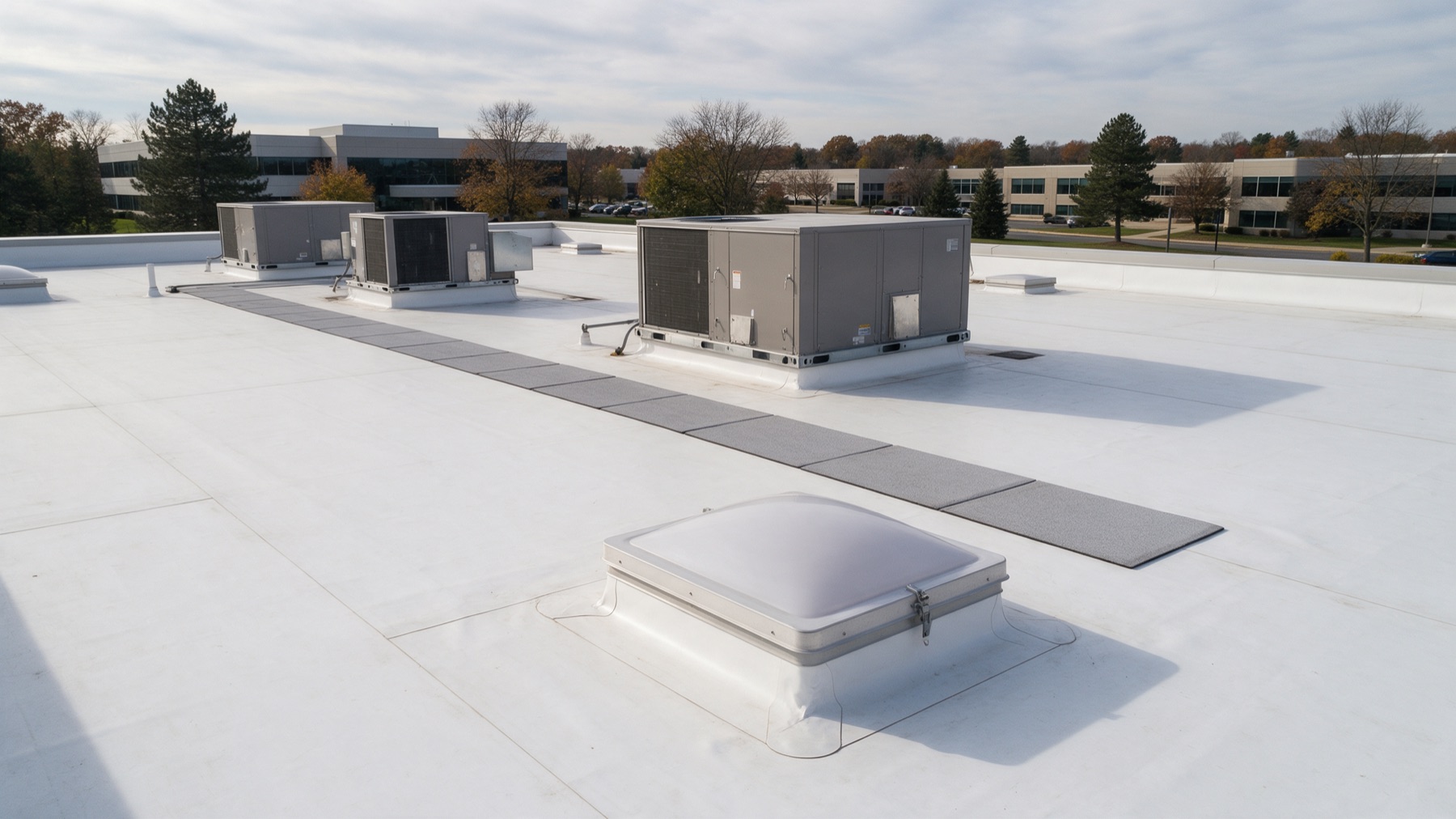
- Walk pads only, from the hatch to the units. If a unit has no path to it, that gap goes on the roofer's list.
- Tools, parts, filters and panels go on pads or a contractor-supplied drop mat, never on bare membrane.
- No ladders, lifts or carts on the membrane without protection boards.
- No smoking, open flame or brazing on the roof without a hot-work permit and the roofer's sign-off.
4. Nothing gets cut, fastened or flashed by the wrong trade
- No new penetrations, curbs, sleepers, pipe supports, conduit runs or antenna mounts without written approval from the building owner, and a roofer approved by the manufacturer doing the flashing. Rimkus recommends that the roofing contractor, not the HVAC technician, handles curb flashing.
- No sealant, tape or "temporary" patches on the membrane by anyone other than the roofer.
- Electrical, gas and refrigerant work stays with licensed trades. Your policy controls how they treat the roof, not how they do their work.
5. Leave it as you found it
- Everything carried up comes down: old filters, belts, screws, packaging and cut-offs.
- Panels refitted and condensate lines reconnected and draining to their intended point.
- Any damage the contractor caused or saw is reported before they leave, not at the next invoice.
What your facility team does, without walking the roof
The policy is enforced from the hatch and the front desk.
- Keep the log. Check it against your HVAC invoices every quarter. A service visit that appears on an invoice but not in the log means someone went up unrecorded.
- Take photos at the hatch. If your team is trained and the roof is dry, take a before and after photo of the walk path and nearby units from the hatch opening, under the OSHA rules above. Use the same spot and the same angle each time.
- Book a roof check after service visits. Rimkus suggests inspecting the roof within two weeks of HVAC service, so that any damage can be tied to the visit. Your roofer can fold this into a scheduled roof maintenance program.
- Keep the paperwork together. Keep the access log, HVAC service reports and roofer inspection reports in one folder. Rimkus describes that combined record as a defensible maintenance history, and it is what you will be asked for if you make a warranty claim.
- Watch the ceiling below the units. A new stain under a rooftop unit after a service visit is the first clue. Our guide to reading a ceiling stain covers what to log.
Your team does not patch, seal, probe or wash the membrane. Observation and records only.
When it becomes a roofer's job
Call a roofer when:
- A unit has no walk pad route, or the existing pads are torn, missing or loose
- The log or photos show a cut, puncture, dent or debris near a unit after a service visit
- A curb flashing is split, pulled away or smeared with sealant
- Anyone wants to add, move or remove rooftop equipment, supports or penetrations. Get the roofer and the manufacturer's approval in writing first.
- Water stands around a unit, or condensate has been running onto the membrane
- A stain appears below rooftop equipment
Punctures and flashing faults are commercial roof repair work. On a single-ply roof, adding manufacturer walkway pads is usually a small job compared with the leaks it prevents. Our TPO roofing page explains how those membranes are put together.
FAQ
Who pays when an HVAC contractor damages our roof?
It depends on your service contract and your roof warranty. Many warranties exclude damage caused by other trades, so the manufacturer may not pay. A signed access log and before-and-after photos are what let you pass the cost back to the contractor.
Can our HVAC company flash a new curb themselves?
They can, but on a warranted roof it can put your coverage at risk. Manufacturers generally expect penetrations and flashings to be done by one of their approved applicators. Check with your manufacturer before any work starts.
Do we really need walkway pads to every rooftop unit?
Wherever equipment gets regular service, a pad path is the cheapest protection the membrane can have. If a unit has none, ask your roofer to price pads compatible with your membrane.
How often should the roof be checked after HVAC service?
Rimkus suggests within two weeks of the service visit, so any damage can be linked to it. Many owners line this up with spring and fall maintenance.
If contractors are on your roof more often than your roofer is, book a free 30-minute consultation or call 202-798-7663. We'll look at your access routine and your warranty terms and tell you where the gaps are.
Header image: AI-generated illustration (Magnific).