The storm went through overnight. By 8 a.m. someone will ask whether the roof is all right, and the honest answer at that point is usually "nobody knows yet." A commercial roof inspection after a storm doesn't have to start with a roofer on site. Most of what you need to know in the first hour can be found by your own facility team — from inside the building and from the ground — in about 30 minutes.
This post is that routine: what to check, in what order, how to record it so it is useful to a roofer or an adjuster, and where it stops being your team's job. It is written for property managers, building engineers and boards, not homeowners.
First, what the industry actually recommends
The National Roofing Contractors Association's position is blunt: after severe weather, owners should assess roof damage from ground level and leave closer assessment and repairs to a professional roofing contractor. NRCA has also told business owners to never climb onto a damaged roof to repair it themselves.
That shapes everything below. The morning-after check is built so that most of it never puts anyone on the roof. The one optional rooftop step is only for a team that already walks the roof under a written fall-protection program — and only when conditions allow.
Two timing rules before anyone moves:
- Wait out the lightning. The National Weather Service advises waiting 30 minutes after the last thunder before going back outside. A roof is the most exposed place on the property.
- Nobody goes onto a wet, windy, icy or debris-covered roof. Wet single-ply membrane is slick, and storm debris hides holes, glass and displaced equipment. If the roof is still wet, the rooftop step waits.
The 30-minute check
Run it in this order. The inside of the building tells you where to look outside.
What the inside tells you
A new stain directly below a rooftop unit, a drain or a wall points to a different cause than one in the middle of the floor plate. Mark every stain on a floor plan. Water travels along the deck and insulation before it drips, so the stain is a clue to the area, not the exact spot. That is the roofer's problem to solve — your job is to tell them where water came out.
What the outside tells you
Overflow scuppers or overflow drains running after the rain has stopped is the most useful thing you can see from the ground. Overflows are a backup. If they carried water, the primary drains were probably blocked or undersized for that storm, and water stood deeper on the roof than it should have. That is worth a call even if nothing has leaked yet.
Metal edge and coping are the parts most often lifted by wind, and once an edge lifts, the membrane behind it is exposed. If you can see a section standing proud from the ground, treat it as urgent.
Pieces on the ground — strips of membrane, flashing, insulation board, fasteners — mean something on the roof came apart. Bag them and keep them. They are evidence.
The optional rooftop step (trained teams only)
If your team already walks the roof under a written program, a short look from the hatch area can confirm what you saw from below. Only if the roof is dry, the wind has dropped and lightning is long gone. Never alone.
The OSHA low-slope rules under 29 CFR 1910.28(b)(13) still apply:
Skylights are holes; storm debris can hide them, and wind can crack their domes. Our fall roof maintenance checklist covers these rules in full.
On the roof, look — don't touch the membrane:
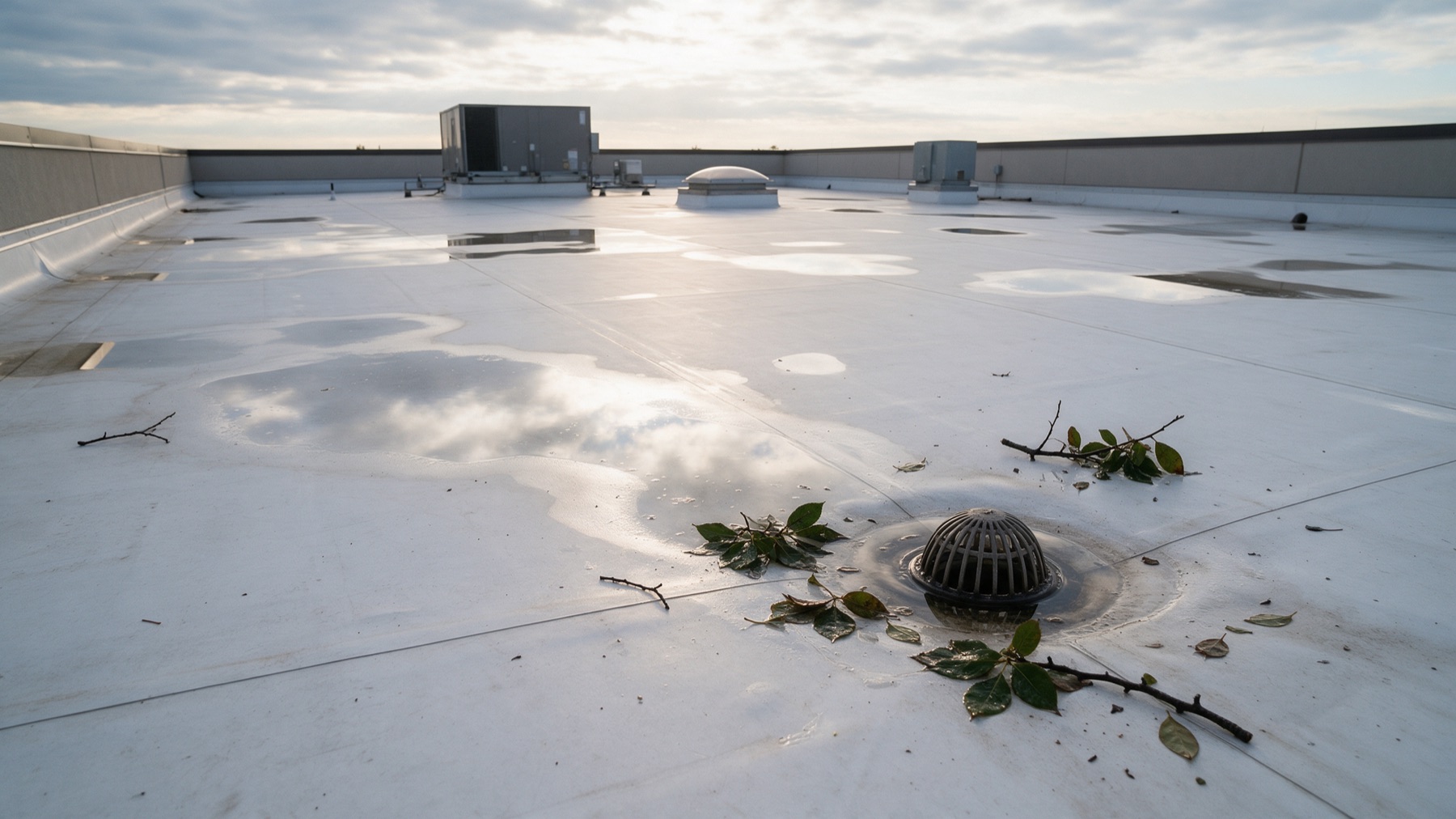
- Are drain strainer domes still in place, and is debris piled on them? Clearing loose leaves and branches from a drain is housekeeping. Anything stuck to or embedded in the membrane stays where it is.
- Is water standing in wide areas? A puddle the morning after is normal. NRCA's benchmark is water that remains 48 hours after rain in drying conditions — check the same spots again in two days.
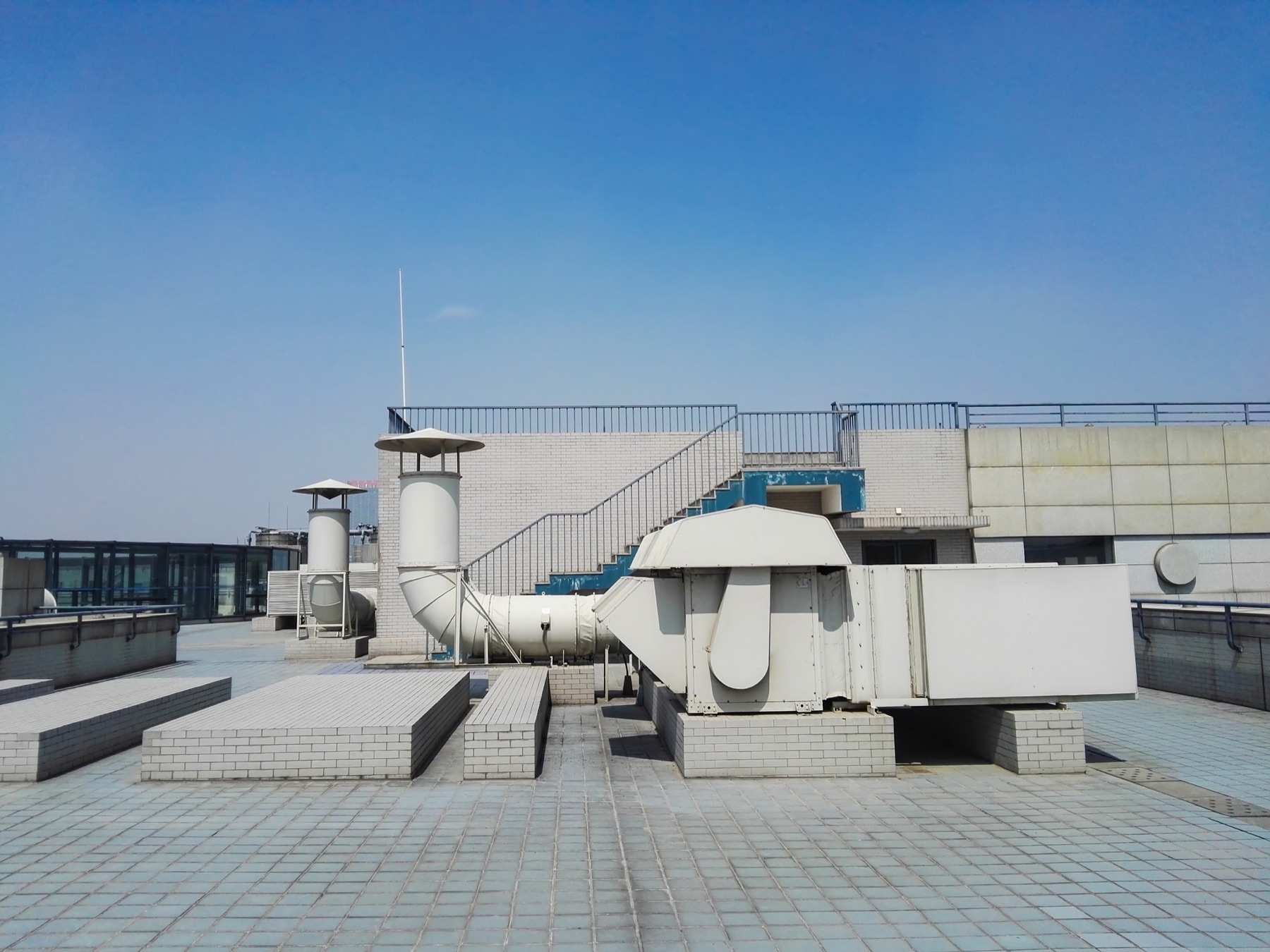
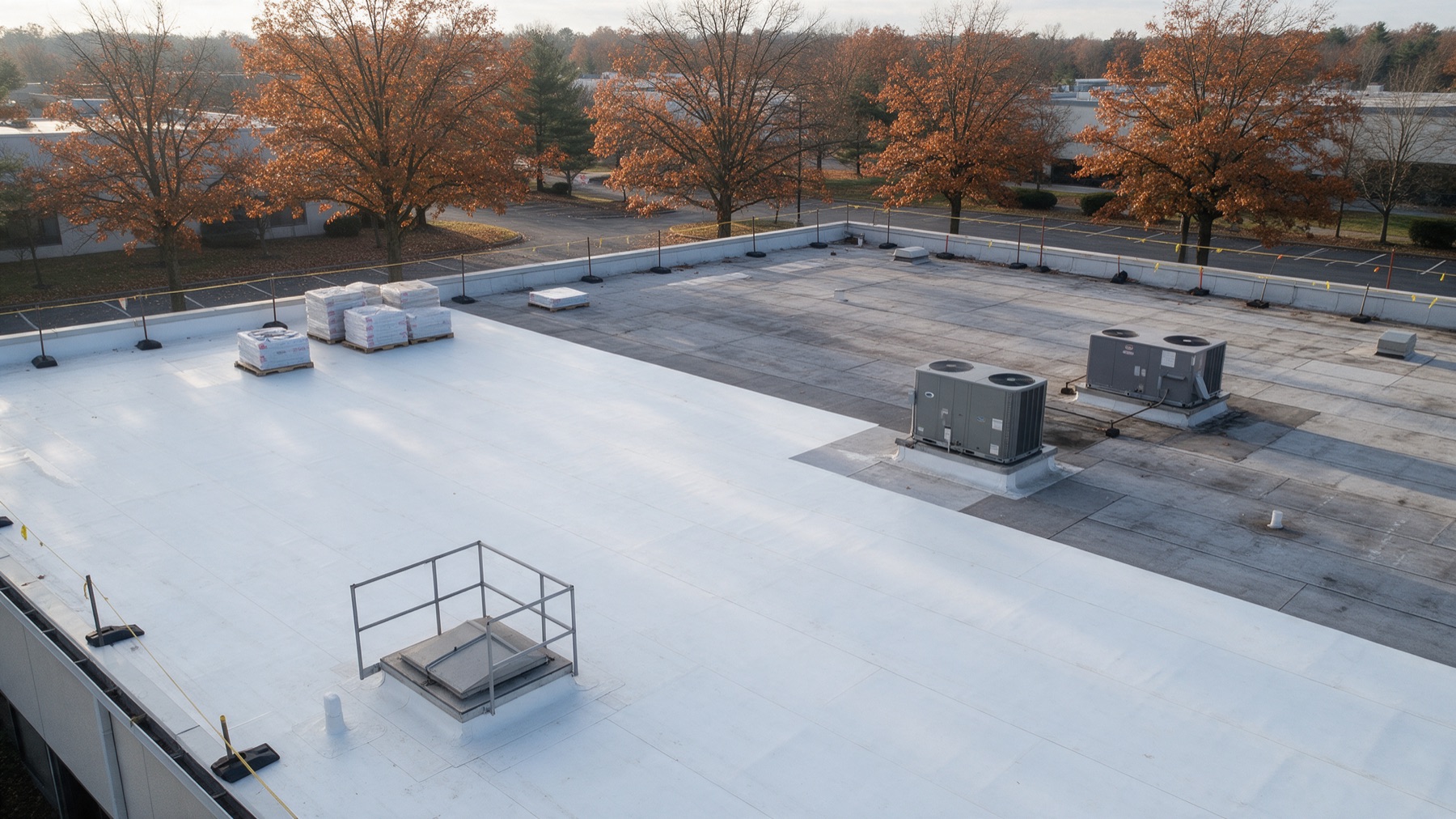
- Has any rooftop unit shifted on its curb, or lost a panel? Don't touch it. HVAC equipment goes to your licensed mechanical contractor, and anything electrical goes to an electrician.
- Are there branches, glass or loose metal on the field of the roof? Photograph before anything is moved.
Anything near the perimeter — lifted edge metal, a damaged parapet cap, a hanging gutter — gets photographed from 15 feet back or more, and goes on the roofer's list.
How to record it so it is worth something
A storm is when documentation pays for itself, whether the next step is a repair, a warranty call or an insurance claim.
- Date and time on everything. Phone photos carry it in the file data; keep the originals, don't only forward screenshots.
- Wide shot, then close-up. A close-up of a stain with no context is hard to locate later.
- Same spots as your routine photos. If you already photograph fixed points on the roof each season, the before-and-after comparison is the strongest evidence you can give an adjuster.
- Note what you did. "Moved two branches off drain 3 at 9:15" protects you if anyone later asks how damage happened.
- Read your policy and warranty for notice deadlines. Insurance policies and roof warranties commonly require prompt notice of damage. Check your own documents for the actual terms rather than assuming.
If the damage looks like it will become a claim, our storm damage and insurance claims page explains how a roofer's condition report fits into it.
What not to do
- Don't patch, seal or tarp the membrane yourself. Temporary repairs on a low-slope roof are a roofer's job; the wrong material or fasteners can make the damage worse and put the warranty at risk.
- Don't cut, probe or lift anything to see underneath.
- Don't let a door-knocking contractor onto the roof because they happen to be in the neighbourhood after a storm. NRCA warns owners to be wary of deals that sound too good to be true. Use a contractor you have vetted.
- Don't go up at night, in wind, or alone.
When it becomes a roofer's job
Call a roofer the same day if any of these turn up:
- Active water coming into an occupied space
- Lifted or missing edge metal, coping or flashing
- Membrane torn, displaced or visible on the ground
- A rooftop unit shifted on its curb (call your HVAC contractor too)
- Overflow drains or scuppers carried water
- Standing water across wide areas, or still there 48 hours later
- A skylight cracked or broken
Active leaks are commercial roof repair territory and shouldn't wait for a scheduled visit. Everything else — the "it's probably fine but I want to know" findings — is what a professional post-storm inspection is for.
Property in Miami-Dade too? Our sister company MIA Roofers covers the hurricane-country version for homes: how to check your roof after a hurricane — safely, from the ground.
FAQ
Should we inspect a flat roof after every storm?
After any severe storm — high wind, hail, heavy rain or a named storm's remnants — yes. NRCA recommends an inspection after major weather events in addition to the routine spring and fall checks. For routine rain, your regular schedule is enough.
Can our maintenance staff go on the roof after a storm?
Only if they already work under a written fall-protection program, the roof is dry and calm, and lightning has passed. Otherwise the check is done from inside and from the ground, which is what NRCA recommends for owners.
How do I know if there's hidden storm damage on a commercial roof?
You often can't from the ground. Wet insulation under an intact-looking membrane is common after wind-driven rain. A roofer can confirm with a moisture survey or core cuts.
Should I call my insurance company or a roofer first?
Read your policy for its notice requirements, then get a qualified roofer to document the condition. A clear, dated condition report and your own photos make the conversation with the adjuster much easier.
If the morning after a storm turns up something you aren't sure about, book a free 30-minute consultation or call 202-798-7663. We will tell you whether it needs a roofer today, this week or not at all.
Header image: AI-generated illustration (Magnific).