The first snow on a flat roof is rarely the problem. The problem is what it hides: a drain buried under a drift, a strip of ice along the edge, a membrane that has been carrying more weight than it was designed for since the last thaw. By the time someone sees a stain on the top-floor ceiling, the damage has usually been building for a week.
Winter is when a facility team's job on a commercial roof changes. Most of what it can do happens from the ground and from inside the building. The shovel does not belong in that list. This post covers what to watch for, where the line sits, and how to handle ice melt if your team is ever asked to use it.
Why snow on a flat roof is different
A pitched roof sheds snow off its edge. A low-slope roof holds it. Three things make that matter.
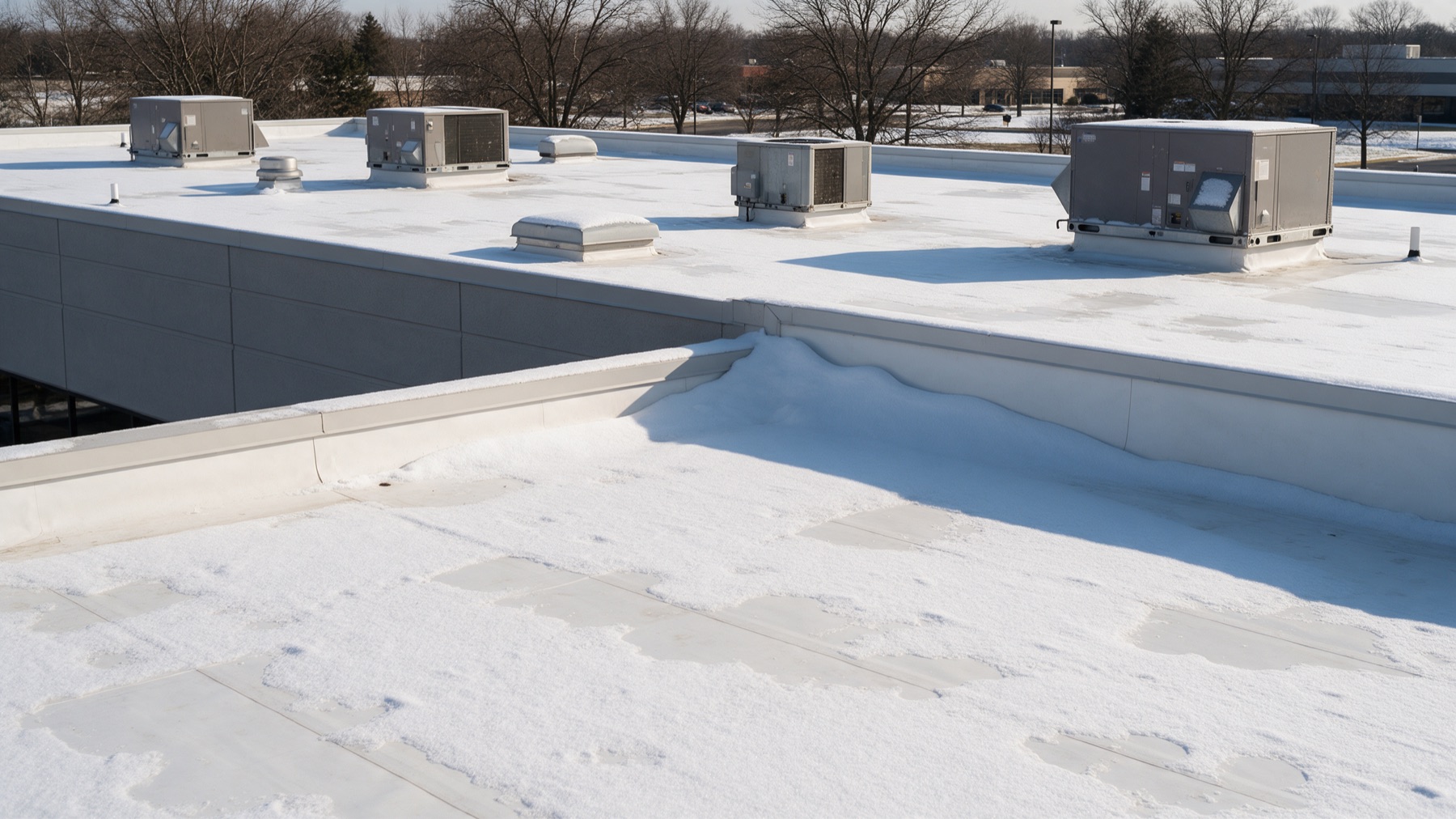
Drifts. Wind pushes snow until it piles against anything that stands up: a parapet, a rising wall, a rooftop unit or a curb. Those drifts are deeper than the snow around them, and they sit on the spot where the roof is already most stressed.
Drains. A drift that covers a roof drain or scupper stops the water it was meant to carry. Meltwater then has nowhere to go, refreezes, and backs up under the membrane at the next thaw.
Load. Every building is designed for a snow load, and the number is on the drawings. The International Building Code requires the structural drawings to show the ground snow load (pg) and, where that value is above 10 psf, the flat-roof snow load (pf) as well (IBC 2021, Section 1603.1.3). If your team cannot find those figures, ask the engineer of record for the building. Do not estimate the load from how the roof looks.
Why your team should not clear the roof
This is the part that matters most, and it has two sources.
The first is OSHA. Under 29 CFR 1910.22(a)(3), walking-working surfaces must be maintained free of hazards that include snow and ice. The same section requires that surfaces be inspected and that hazardous conditions be corrected or guarded before anyone uses them again (1910.22(d)). Read carefully, that obliges you to keep people off an icy roof. It does not license staff to go up with a shovel.
The second is the roofing trade's own guidance. The National Roofing Contractors Association advises that snow should come off a roof only when it can be done safely from the ground, using a roof rake or an extended-handle broom. It says NRCA does not recommend using ice picks, shovels or any tool with sharp edges that may damage roof coverings. Where snow or ice cannot be removed safely from the ground, the advice is to call a professional roofing contractor (NRCA guidance as reported in Roofing magazine, November 2019).
Put those together and the rule for your team is simple. Stay off the roof in snow and ice. Edge exposure is the same as always: the OSHA low-slope edge rules apply the moment anyone is up there, and a snow-covered edge is the hardest one to see.
What your team can watch from the ground and inside
These are the checks that need no roof access at all.
The roof plan you already have from the fall checklist helps here. Mark every drain and scupper on it, tape a copy by the hatch, and walk the ground-level view once a week after each snowfall.
Ice melt: what to use, and what it can do
Sometimes a building manager reaches for a bag of melt. Before anyone spreads it on a roof, understand two things.
The product matters. Carlisle states that ice melts containing potash, urea, calcium chloride and sodium chloride are safe to use on its EPDM, TPO and PVC membranes (Carlisle TecTopics). Versico says EPDM resists rock salt and calcium chloride when they are applied as the supplier recommends (Versico). Those lists are specific to each manufacturer, so get the approved-product list for your own membrane and do not assume a product is fine because it is sold for driveways.
The application matters more. Versico describes rock salt as a hard, crystalline product that can damage the membrane if walked on after application, and says calcium chloride pellets can do the same before they dissolve. Its advice is to limit foot traffic over any area that has been treated. Carlisle warns that ice melts will discolor copper, corrode and pit aluminum, and accelerate rusting of non-stainless steel, and that protecting metal components is the owner's responsibility. Keep product off exposed flashing, scuppers and coping.
Two cautions for your team. Do not apply melt from the roof; if the product needs to go on the roof, the roofer applies it. And do not treat melt as a substitute for removal. A melt that is spread over a deep drift still has to be watered down and drained.
Build the winter plan before the first snow
The best snow plan is written in October. A one-page version is enough.
- Who calls, and whom. Put the roofer's emergency number, the engineer's number and the building engineer's name on the same sheet, and tape it inside the hatch.
- Where the snow goes. Mark the drains, scuppers and any rooftop units that drift most, on the roof plan.
- Photo points. Pick five fixed points you can see from the ground or a window, and photograph them after every significant snowfall and again at the first thaw.
- A log. Record the date, the storm, what you saw from each point, and any call you made. A warranty claim or an insurance file is much easier to build from a dated log than from memory.
- Who may clear snow. Put it in the snow-removal contract, if you have one. Require a crew insured for roof work, and say in the contract that ground-level methods come first. Ask any contractor which membrane-approved methods and products they use before they go up.
The after-storm check covers the same ground-level routine for any severe weather, and the rooftop access policy covers what to ask for when other trades go up in winter.
When it becomes a roofer's job
Your team's job ends at observation, photographs and calls. Get a roofer on the roof when:
- a drift is covering a drain, scupper or curb, or is above the top of a parapet
- ice is forming at the edge, or water is coming back under the membrane
- there is a new stain or drip inside, at any point during winter
- the ceiling sags, cracks or the doors start to stick
- you cannot tell whether the snow on the roof is a load problem
If you have water coming through the roof now, that is a leak repair call, not a snow question. If the same winter problems keep returning, a maintenance program with scheduled professional visits usually costs less than responding each time.
FAQ
Can our maintenance staff shovel snow off a flat roof?
No. The NRCA advises that snow should come off a roof only from the ground, with a roof rake or an extended-handle broom, and not with shovels or ice picks. Where that cannot be done safely, a professional roofing contractor should do it. Any work on a snow-covered roof also falls under the OSHA edge rules.
How do I find the design snow load for our building?
Look at the structural drawings for the ground snow load (pg) and the flat-roof snow load (pf). The building code requires both to be shown where pg is above 10 psf. If the drawings are not on file, ask the engineer of record. Do not guess from how much snow is on the roof.
Is it safe to use ice melt on a TPO or EPDM roof?
Some products are approved for specific membranes, and the damage often comes from how the product is applied and walked on. Get the approved-product list from your membrane manufacturer and keep melt away from metal flashing, scuppers and coping. Have the roofer apply it.
If your winter plan has gaps or you want a second opinion on a drift or a ceiling stain, book a free 30-minute consultation or call 202-798-7663. We will tell you whether it needs a roofer at all.
Header image: AI-generated illustration (Magnific).