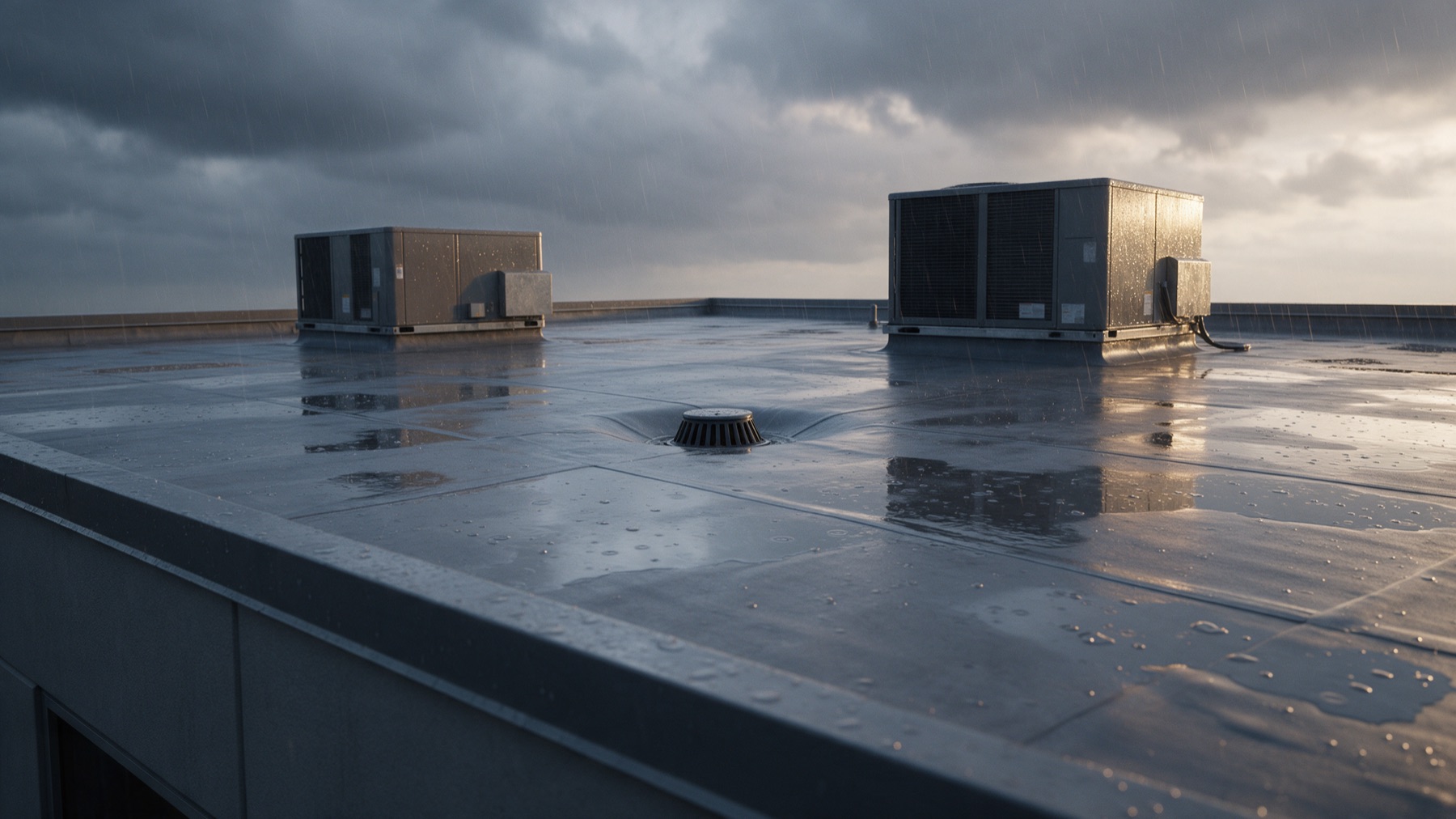
The call comes in at 2 p.m. in the middle of a storm: water is coming through the ceiling on the top floor. A commercial roof leak emergency is mostly a test of the first hour. What your team does in that hour decides how much damage the interior takes, how clean the paper trail is for the insurer or manufacturer, and whether anyone gets hurt.
This post is a script for that hour. It is written for property managers, building engineers and boards, and it is built on one rule: the response happens inside the building. Nobody goes on the roof during the storm.
Why the roof stays off-limits while it is raining
Emergency work on a roof in severe weather is dangerous because of wind and lightning, and FacilitiesNet's guidance on emergency roofing repairs says repairs should generally wait until severe weather has ended. NRCA is blunter for owners: assess from the ground and never climb onto a damaged roof to repair it yourself, because the fall risk is too great without proper safety systems.
Wet single-ply membrane is slick, and a flooded roof can hide drains, skylights and soft spots. If your team later goes up under a written program, the OSHA low-slope edge rules apply; our fall roof maintenance checklist lays them out, and 29 CFR 1910.28 is the source (osha.gov). Skylights are holes.
The first hour, in order
Minutes 0–10: people and power first
Water and ceilings are a hazard before they are a repair problem. A ceiling that is bulging, sagging or cracking may be holding a lot of water above it. Keep people out from underneath it. Do not poke at it; call for someone qualified to assess it, because the whole section can come down.
Water at or near a light fitting is an electrical question, not a facilities one. Electrical work belongs to a licensed electrician. Your job is to keep people away and get the right trade there.
Minutes 10–25: contain, don't chase
You will be tempted to find the hole. Don't, yet. On a low-slope roof the place water shows up inside is often not directly beneath where it comes in, because it travels along the deck and insulation first. FacilitiesNet notes that finding the source can be difficult and, if it can't be found, the team may need to contain the water until a roofing professional arrives. That is the right target for this hour: contain and protect.
- Use buckets and plastic sheeting; move computers, files, stock and carpeted furniture out of the zone.
- Pull wet ceiling tiles only if the area is clear of fixtures and the grid is stable; bag and keep them as evidence.
- Do not drill, cut or open the ceiling above you to "release" water.
Minutes 25–50: document while it is happening
A leak that is documented live is much easier to defend than one reconstructed afterwards. Take photos with date and time intact (keep the originals, not screenshots), note the weather, and mark stains on a plan of the floor. Include wide shots, close shots and one with a tape measure or familiar object for scale. If the storm also brought down debris, our storm check routine covers the ground-level walk-round.
If overflow scuppers or overflow drains are running, write that down and photograph it. It suggests primary drains were blocked or overwhelmed, which matters to the repair and to the maintenance record.
What not to do
After the first hour: dry it out
Once the water has stopped, drying matters. The EPA advises fixing water problems as soon as possible and drying everything completely, and notes that porous materials like ceiling tiles may have to be thrown away if they become moldy. Have a restoration contractor assess wet insulation, drywall and carpet instead of assuming the surface is the whole story. Wet roof insulation is a separate question for your roofer, and a leak that has soaked insulation is one reason a coating or patch may only be a delay.
When it becomes a roofer's job
Everything on the roof. Specifically:
- Locating the leak and any moisture survey of the insulation.
- Temporary protection (tarps, temporary sealing) once the weather allows: a contractor installs it with fall protection.
- Any repair of membrane, flashing, curbs, edge metal or penetrations, done in a way compatible with your roof system and warranty. Ask for the manufacturer-approved method if the roof is under warranty.
- Rooftop equipment that has shifted or lost panels: HVAC contractor, and an electrician for anything electrical.
For a first call, give the roofer your photo set, the floor plan with marked stains, the roof age and system if you know it, and the times. That turns a first visit into a diagnosis rather than a search. Our roof repair and storm damage and insurance claim pages describe how that process works.
Frequently asked questions
Should I put a tarp on my commercial roof myself during a storm?
No. Wind and lightning risk during the storm, a slick surface and unguarded edges make it a job for a roofing contractor once the weather clears. Protect the interior in the meantime.
How do I stop a roof leak from inside a commercial building?
You usually can't stop it from inside; you contain it. Divert drips into containers, cover contents with plastic, keep people clear, and have an electrician make any wet fixtures safe. The source is repaired from the roof by a professional.
Who do I call first when the roof leaks: roofer, insurer or tenant?
Make safety calls first (security, electrician). Then call the roofer, since they take longest to schedule, and notify the insurer and affected tenants in the same hour. Check your policy and lease for notice requirements; they vary.
Will my insurance cover a roof leak?
That depends on your policy, the cause and the condition of the roof. Photos, a timeline and a maintenance record help. Ask your broker or carrier what notice and mitigation steps your policy expects.
How long until a leaking roof is repaired?
It depends on weather, access and the repair. Temporary protection can often be placed once the weather allows; permanent work is scheduled after the cause is found. Ask your contractor for a realistic timeline in writing.
Get the roof looked at properly
If you have had a leak, a written condition report is the next step. Book a free 30-minute consultation at https://dmvcommercialroofing.com/#book or call 202-798-7663.
Header image: AI-generated illustration (Magnific).