If you own or manage a privately owned building over 50,000 square feet in the District, the first Building Energy Performance Standards compliance cycle closes on 31 December 2026. That is roughly four months from now, and the final calendar year of energy-use data is reported to DOEE the following spring.
A roof is not a compliance strategy on its own. But it is one of the few envelope moves that is both measurable and something you were probably going to spend money on anyway — and the sequencing decision is time-sensitive in a way most owners have not thought about.
Verify the specifics for your building with DOEE before you act on any of this; thresholds and pathways have been revised more than once.
What BEPS actually asks of you
In broad terms, Cycle 1 applies to privately owned buildings over 50,000 sq ft and District-owned buildings over 10,000 sq ft. Buildings in scope have to either demonstrate a reduction in site energy use intensity across the cycle, or meet the performance standard set for their property type by the end of it.
Separately, benchmarking obligations have been extending downward — reaching privately owned buildings down to 10,000 sq ft — so a building too small for Cycle 1 may still be reporting, and may well be in scope for a later cycle.
The practical reading for a facility team: if your building is in Cycle 1, the measures that count are the ones with data behind them by the end of this calendar year.
Where the roof contributes
Two mechanisms, and it is worth being honest about the size of each.
Insulation. This is the larger and more durable one. The District enforces the 2017 DC Construction Codes — the 2015 ICC model codes as amended by DCMR Title 12 — and the energy provisions for a low-slope roof in climate zone 4 call for roughly R-30 continuous above the deck. A building from the 1970s or 80s often has half that. Replacing the roof forces the assembly up to current requirements, and that is a permanent reduction in heating and cooling load rather than an operational tweak that can drift back.
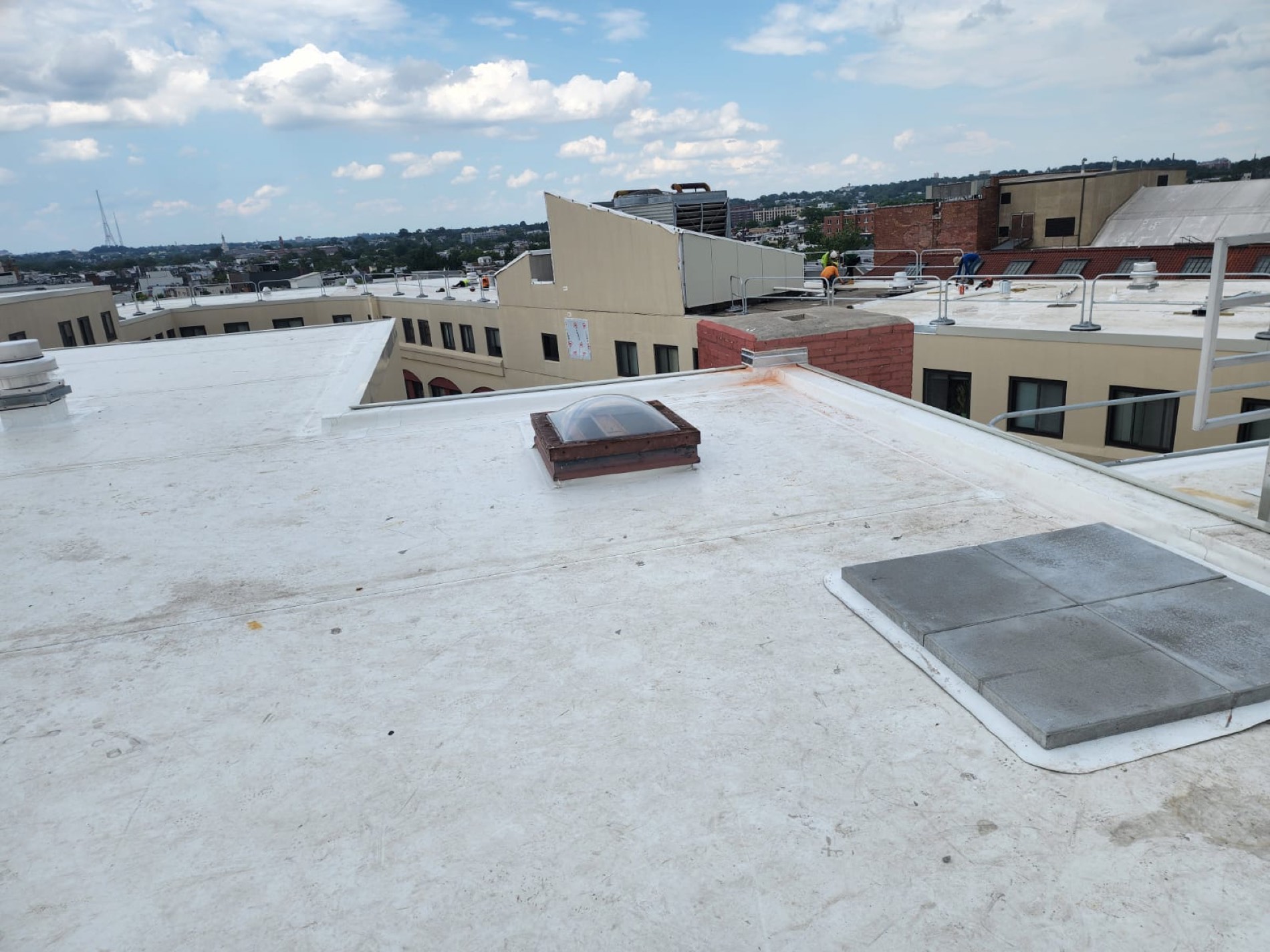
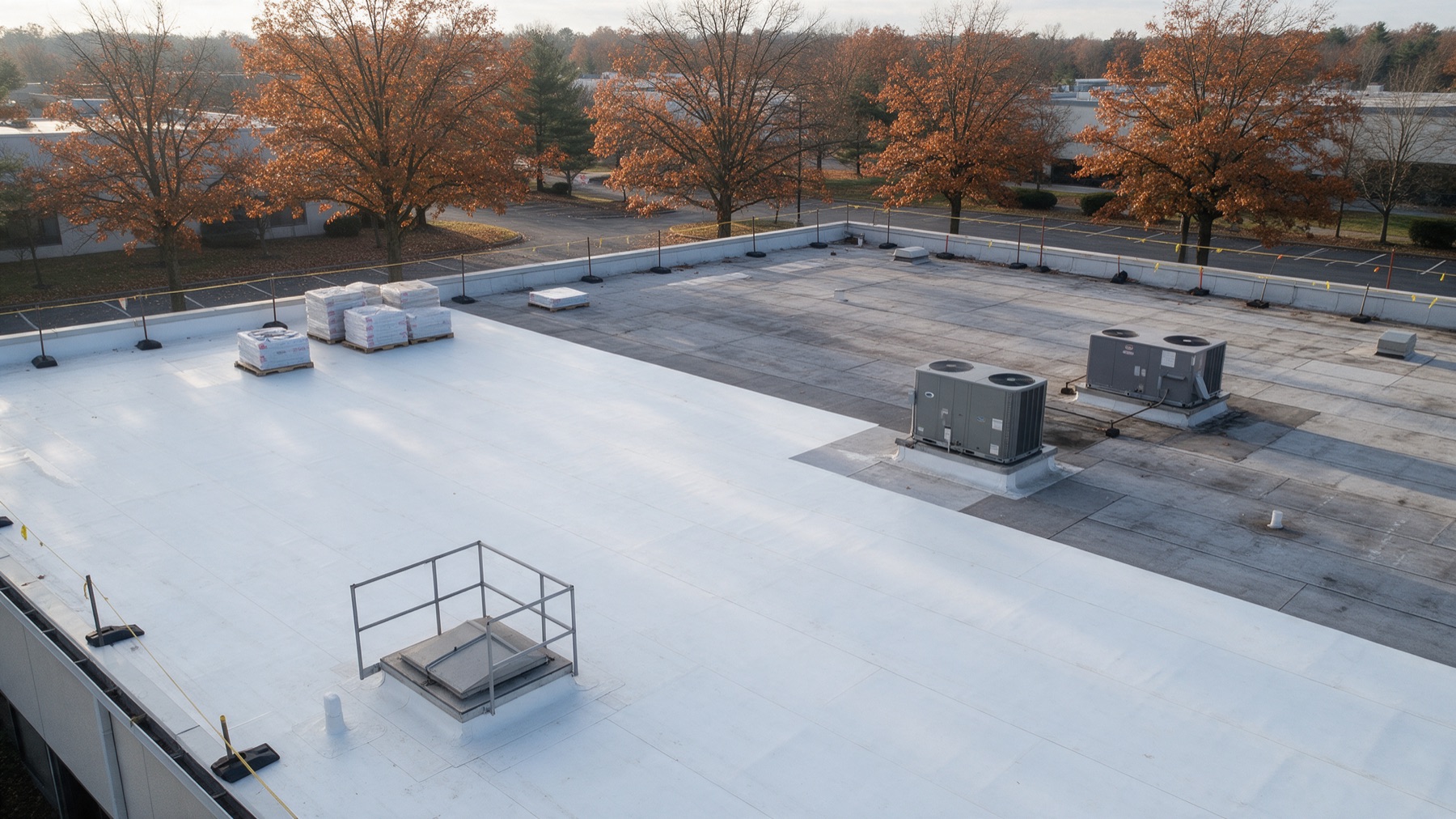
Reflectivity. A white membrane meaningfully lowers rooftop surface temperature, which takes load off rooftop HVAC through the cooling season. On a building with significant summer cooling demand and units working hard on the roof, that shows up in consumption. On a heating-dominated building it matters much less, and anyone telling you a cool roof is a universal win is selling.
What a roof will not do is carry an entire compliance gap by itself. Envelope work is usually a contributor alongside controls, lighting, HVAC scheduling and equipment replacement. Treat it as the piece of a plan that also happens to solve a capital problem.
The sequencing decision that actually has a deadline
Here is the part that catches people.
If your roof is at or near end of life and you are also considering rooftop solar, or additional mechanical, or a green roof for stormwater retention — the roof goes first. Installing an array or new equipment over a membrane with five years left means paying to dismantle and reinstall it when the roof fails, and that cost frequently exceeds the roof replacement itself.
The District makes this more pointed than most jurisdictions, because stormwater retention requirements are aggressive here and green roofs count toward them. DOEE has run rebate programmes for voluntary green roof installation, weighted toward the MS4 area and Wards 7 and 8, and the Stormwater Retention Credit market lets qualifying installations generate tradeable credits. Funding and programme status change year to year — confirm current terms with DOEE rather than budgeting from an old figure — but the design decision has to be made before the roof is specified, not after.
A roof, a green roof, an array and a mechanical replacement done as one coordinated sequence cost dramatically less than the same four done separately over six years.
What this does to your schedule
Two constraints collide in the District.
Historic review. DC has a large number of historic districts and individually landmarked buildings. Where roof work is visible from public space — and anything touching a parapet, coping, penthouse or roofline usually is — Historic Preservation Office review comes before the permit issues. Plan in weeks, not days. It is the single most common reason a DC roofing schedule slips.
Public space and access. Downtown jobs frequently need more than a building permit: public space occupancy for a dumpster or crane, DDOT closures, after-hours agreements in mixed-use buildings. On a tight site those approvals drive the schedule more than the roofing does.
Add the weather window — a roof opened in late November here is a gamble — and a replacement you want completed inside this calendar year needed to start its permitting conversation some time ago. If the goal is Cycle 1 data, the realistic move now is to get the condition assessment and the design decisions settled so the work lands early in the next window rather than missing both.
What to do in the next month
- Confirm whether your building is in Cycle 1, and which compliance pathway you are pursuing, with DOEE.
- Get a condition report on the roof — system, remaining service life, insulation currently in place, and whether the substrate is dry. You cannot evaluate any of the above without knowing whether you are looking at a replacement or a restoration.
- Decide the sequence — roof, then solar, then equipment. Not the other way round.
- Identify the historic review exposure early, because it is the long pole.
- Ask what the insulation upgrade does to parapet heights, thresholds and curbs. On older District stock this is a design question, not a field improvisation.
FAQ
Does replacing my roof make my building BEPS compliant?
On its own, almost never. It reduces envelope load permanently and is usually a meaningful contributor, but compliance normally comes from a combination of envelope, systems and operations. It is best understood as capital spend you had planned that also moves the number.
Is a white roof always better in DC?
Not always. It reduces cooling load, which helps in a cooling-dominated building with heavy rooftop mechanical. In a heating-dominated building the benefit is smaller. The building's actual load profile decides it.
Should I install solar before or after replacing the roof?
The roof first, unless it genuinely has twenty-plus years left. Installing over an aged membrane means paying to remove and reinstall the array when the roof fails — often more than the roof replacement itself.
What does a commercial roof replacement cost in the District?
DC generally sits at the upper end of the regional range, commonly around $10 to $19 per square foot for low-slope replacement, because of access constraints, staging, dense rooftop mechanical and public space permitting. Treat that as a planning range; the Washington DC service page covers the local variables in more detail.
Who issues the permit — DCRA or DOB?
The Department of Buildings. DCRA was split in 2022, with plan review and inspections going to DOB and business licensing to DLCP. A contractor still saying "DCRA" has not pulled a District permit recently.
If you need the roof half of this documented — condition, remaining life, insulation in place, and what a code-compliant replacement would involve — book a free 30-minute consultation or call 202-798-7663.